


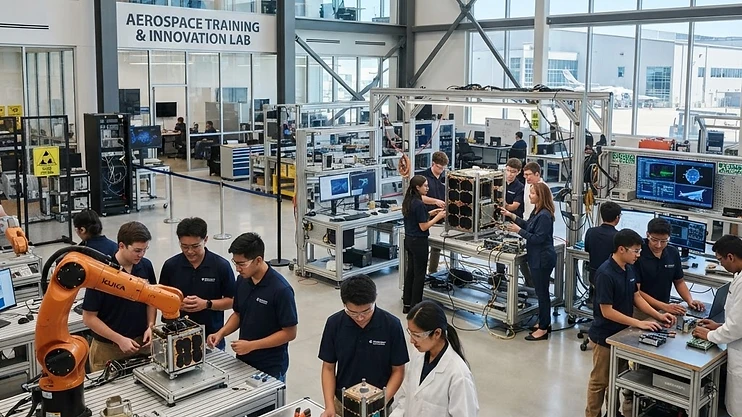
The opening of the ACE facility signals a transition from a 'launch-first' economy to a 'sustainment-first' economy.
The opening of the Eastern Florida State College (EFSC) Aerospace Center of Excellence (ACE) in Titusville this week represents more than just a new building on a campus map; it is a structural response to the relentless cadence of the Space Coast’s launch economy. As launch providers like SpaceX and Blue Origin push toward unprecedented flight frequencies, the bottleneck has shifted from hardware availability to human capital. By centralizing advanced manufacturing and aerospace systems training in the heart of Titusville, EFSC is effectively creating a pipeline that bridges the gap between academic theory and the high-stakes reality of the Kennedy Space Center launch pads.
This development is the culmination of years of pressure on local educational institutions to keep pace with the rapid commercialization of space. With the Space Coast recording over 100 launches annually, the demand for technicians, systems engineers, and specialized maintenance crews has reached a fever pitch. The ACE facility is designed to be the primary engine for this workforce, ensuring that the talent required to sustain the region's dominance is grown locally rather than imported, thereby cementing the Space Coast's status as the premier aerospace hub in the United States.
For local businesses and global contractors alike, this facility changes the calculus of expansion. Companies no longer need to worry about the 'talent desert' that often plagues high-tech manufacturing hubs. Instead, they can rely on a steady stream of graduates trained on the specific, state-of-the-art equipment that mirrors the operational environments of the nearby launch facilities. This is the infrastructure of the future, and it is being built right here in Titusville.
What happened
On October 14, 2026, Eastern Florida State College officially cut the ribbon on its new Aerospace Center of Excellence in Titusville. The facility, which represents a significant capital investment, is designed to provide hands-on training for students entering the aerospace and defense sectors. The center features advanced laboratories, simulation suites, and manufacturing bays that replicate the conditions found in modern aerospace production environments. According to college officials, the curriculum was developed in direct consultation with industry leaders, including major contractors operating out of the Kennedy Space Center and Cape Canaveral. The project was fast-tracked to meet the urgent labor demands identified by the Economic Development Commission of Florida’s Space Coast, which has been vocal about the need for a more robust technical workforce to support the record-breaking launch cadence of 2025 and 2026. The facility is expected to graduate hundreds of students annually, with a focus on certifications that are immediately applicable to the needs of companies like SpaceX, Blue Origin, and L3Harris. The opening ceremony was attended by local government officials, industry representatives, and academic leaders, all of whom emphasized that this center is a cornerstone of the region's long-term economic strategy.
Why it matters
The opening of the ACE facility signals a transition from a 'launch-first' economy to a 'sustainment-first' economy. For years, the focus on the Space Coast was on the spectacle of the launch—the rockets, the fire, and the headlines. However, the real economic value lies in the long-term maintenance, supply chain management, and iterative engineering required to keep these systems operational. By training a local workforce to handle these complex tasks, the region is insulating itself against the volatility of the global aerospace market. If a launch provider decides to shift its primary R&D to another state, the local workforce trained at EFSC remains, providing a stable base of expertise that attracts other high-tech industries to the region.
Furthermore, this facility acts as a magnet for secondary and tertiary aerospace suppliers. When a company like Satys or Dassault Aviation looks at the Space Coast, they are looking for more than just proximity to a launch pad; they are looking for a reliable ecosystem. The ACE facility provides that reliability. It creates a feedback loop where industry needs inform the curriculum, and the curriculum produces the talent that industry needs. This structural alignment is what separates a transient boomtown from a permanent industrial powerhouse. In two to three years, we expect to see a significant increase in the number of specialized aerospace firms establishing satellite offices in Titusville and Melbourne, specifically to tap into the talent pool being cultivated at this center.
The breakdown
- Curriculum alignment: The coursework at the ACE facility is not static; it is designed to evolve alongside the rapid technological shifts in the aerospace industry. By maintaining a direct line of communication with local industry partners, EFSC ensures that students are learning on the same software and hardware platforms currently in use at the launch pads. This reduces the 'onboarding friction' that typically slows down new hires in high-tech sectors.
- Regional economic stability: By focusing on workforce development, the region is building a moat around its aerospace industry. Even if the frequency of launches were to fluctuate, the need for skilled technicians to maintain, repair, and upgrade existing infrastructure remains constant. This creates a baseline of economic activity that is less susceptible to the boom-and-bust cycles of the space economy.
- Titusville’s strategic rise: Titusville is positioning itself as the 'back office' and 'technical hub' of the Space Coast. While the launch pads get the glory, the technical work happens in the surrounding communities. This facility cements Titusville’s role as a critical node in the regional aerospace network, attracting investment and high-paying jobs to the city.
- Public-private synergy: The project is a prime example of how state and local government, academia, and private industry can collaborate to solve systemic problems. Space Florida’s involvement and the support from the Economic Development Commission demonstrate a unified front in addressing the labor shortage. This level of coordination is a competitive advantage that other regions struggle to replicate.
- Advanced manufacturing focus: The center is not just about theory; it is about the practical application of advanced manufacturing techniques. Students are gaining experience with additive manufacturing, precision machining, and automated systems that are essential for modern rocket production. This hands-on experience is what makes these graduates highly sought after by major aerospace contractors.
- Future-proofing the workforce: As the industry moves toward more autonomous and AI-driven systems, the ACE facility is incorporating these technologies into its training programs. This ensures that the local workforce is not just prepared for today’s jobs, but is also ready for the roles that will emerge as the industry continues to evolve. This forward-looking approach is essential for maintaining a competitive edge.
- Attracting new investment: The presence of a dedicated aerospace training center serves as a powerful marketing tool for the region. When the EDC pitches the Space Coast to prospective companies, they can point to the ACE facility as proof of a committed, long-term investment in the workforce. This is a tangible asset that differentiates the region from other aerospace hubs across the country.
Key takeaways
- The ACE facility is a direct response to the labor shortages caused by the record-breaking launch cadence on the Space Coast.
- EFSC is bridging the gap between academic training and the specific technical requirements of major aerospace contractors.
- The center focuses on long-term economic stability by creating a permanent, highly skilled local workforce.
- Titusville is emerging as a critical technical hub, supporting the broader aerospace ecosystem of the Space Coast.
- The facility’s curriculum is designed to evolve with industry needs, ensuring graduates are prepared for future technological shifts.
Our view
Most coverage of the ACE facility focuses on the 'jobs' aspect, but that misses the bigger picture. The real story here is the institutionalization of the Space Coast’s aerospace industry. For decades, the region was at the mercy of government budget cycles and the whims of a few large contractors. By building a dedicated, industry-aligned training center, the region is taking control of its own destiny. We believe this will lead to a 'clustering effect' where the presence of this talent pool will attract a new wave of startups and mid-sized aerospace firms that were previously hesitant to move to the region due to labor concerns. The winners here are the local students and the regional economy; the losers are the regions that continue to rely on 'poaching' talent from elsewhere rather than building it from within. The most common mistake in analyzing this is viewing it as a local college project; it is actually a strategic infrastructure play that will pay dividends for decades.
What to do about it
- For local business leaders: Engage directly with the EFSC leadership to identify specific skill gaps in your current workforce and explore how the ACE curriculum can be adapted to address them.
- For aerospace contractors: Consider establishing internship and apprenticeship programs that allow students to gain real-world experience at your facilities while they are still in school.
- For technical professionals: If you are looking to upskill or pivot into the aerospace sector, take advantage of the certifications and training programs now available at the ACE facility.
- For regional policymakers: Continue to support the funding and expansion of these types of public-private partnerships, as they are the most effective way to ensure long-term economic growth.
The bottom line
The opening of the Aerospace Center of Excellence in Titusville is a watershed moment for the Space Coast. It transforms the region from a launch site into a comprehensive aerospace industrial hub. By investing in the human capital that powers the industry, the community is securing its future against the uncertainties of the global market. This is how a region builds a lasting legacy in the most demanding industry on Earth.