


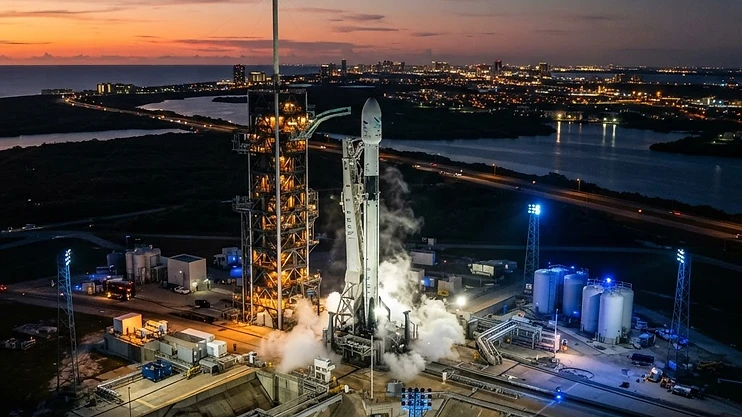
The cadence of rocket launches from the Space Coast has shifted from a periodic spectacle to a daily industrial rhythm.
The cadence of rocket launches from the Space Coast has shifted from a periodic spectacle to a daily industrial rhythm. With over 100 launches recorded in 2025 and projections climbing, the physical infrastructure of Brevard County is being pushed to its absolute limit. This is no longer just about the engineering marvels on the pad; it is about the mundane, critical systems—wastewater, power grids, and road networks—that support the massive workforce and industrial footprint required to sustain this pace.
For companies like SpaceX and Blue Origin, the challenge is no longer just orbital mechanics; it is municipal capacity. As the region prepares for the upcoming MAX POWER expo at the Kennedy Space Center, the disconnect between the high-tech ambitions of the aerospace sector and the aging utility infrastructure of the surrounding suburbs becomes increasingly apparent. The question for local leaders is whether the current state-led funding initiatives can keep pace with the exponential growth of the private space sector.
This tension defines the current era of the Space Coast. While the economic output continues to soar, the daily reality for residents and businesses in Melbourne and Viera involves navigating the growing pains of a region that has become the world's busiest spaceport. The following analysis explores how this infrastructure bottleneck is forcing a new model of public-private partnership that will dictate the region's trajectory for the next decade.
What happened
The surge in launch activity, led by SpaceX’s aggressive Falcon and Starship development programs, has necessitated a massive expansion of ground support facilities. According to recent reports, SpaceX is actively developing new launch pads at Kennedy Space Center, while Blue Origin continues to scale its operations. This industrial expansion has triggered a direct conflict with local municipal capacity. In late 2025, concerns regarding wastewater capacity reached a boiling point, leading to state intervention. Governor Ron DeSantis’s 2026 budget proposal specifically earmarked $5 million for wastewater capacity improvements along the Space Coast, explicitly tied to supporting commercial launch providers. This is a rare instance of state-level funding being funneled directly into municipal utility upgrades to prevent a hard stop on industrial growth. Furthermore, the Economic Development Commission of Florida’s Space Coast has been aggressively lobbying for the establishment of a United States Space Academy, which would further strain local resources while cementing the region's status as the global hub for space operations. The expansion of companies like Relativity Space and the arrival of international firms like Satys have added thousands of high-wage jobs to the region, creating a housing and utility demand that the current infrastructure was not designed to handle.
Why it matters
The second-order consequences of this infrastructure strain are profound. If the Space Coast cannot guarantee reliable utility access, the risk is not just a delay in a launch, but a potential migration of R&D and manufacturing operations to other states with more robust industrial parks. We are seeing a structural shift where the 'Space Coast' is no longer just a geographic location but a specialized industrial zone that requires a dedicated, high-capacity utility grid. In 2-3 years, the winners will be the firms that have successfully integrated their operations with local municipal planning, while the losers will be those who continue to treat local infrastructure as an externalized cost. The integration of STARCOM at Patrick Space Force Base adds a layer of national security urgency to these infrastructure projects, meaning that local utility upgrades are now effectively defense projects. This changes the political calculus for local government; they are no longer just managing a city, they are managing a critical national asset.
The breakdown
- Utility capacity as a competitive moat: The ability to secure wastewater and power permits is becoming the primary barrier to entry for new aerospace startups in the region. Companies that can demonstrate self-sufficiency or partner with the state to fund infrastructure will gain a significant time-to-market advantage over competitors. This creates a new dynamic where infrastructure investment is as important as R&D investment.
- The STARCOM influence: The permanent establishment of the Space Training and Readiness Command at Patrick Space Force Base elevates the region's infrastructure needs to a matter of national security. This provides a pathway for federal funding that was previously unavailable to local municipalities. It also ensures that the Space Coast will remain a priority for state and federal infrastructure grants for the foreseeable future.
- The housing-infrastructure feedback loop: As aerospace firms bring in thousands of engineers, the demand for housing in Viera and Melbourne has skyrocketed. This residential growth competes with industrial growth for the same limited utility capacity. Local planners are now forced to choose between prioritizing high-density residential development or industrial expansion, a choice that will define the character of the region.
- State-level intervention: The $5 million allocation for wastewater capacity is a signal that the state of Florida views the Space Coast as a singular economic engine. This sets a precedent for future state-led infrastructure projects that bypass traditional local funding models. It effectively centralizes control over the region's growth trajectory.
- Logistics and road congestion: The sheer volume of heavy equipment and personnel moving to and from Kennedy Space Center and Cape Canaveral is testing the limits of local road networks. Future infrastructure projects will likely focus on dedicated logistics corridors to separate industrial traffic from residential commuters. This will be a major point of contention in local zoning meetings.
- The MAX POWER catalyst: The upcoming MAX POWER expo is not just a public relations event; it is a stress test for the region's ability to host large-scale international events. The success of this event will likely dictate the appetite for future large-scale infrastructure investments. It serves as a showcase for the region's capabilities to global investors.
- Private-public utility partnerships: We are seeing the emergence of a new model where private aerospace firms co-invest in public utility infrastructure. This is a departure from traditional tax-based funding and represents a more sustainable, albeit complex, approach to industrial growth. It requires a high level of transparency and cooperation between private firms and local government.
Key takeaways
- Infrastructure capacity is now the primary constraint on Space Coast aerospace growth.
- State funding is increasingly being used to solve municipal utility bottlenecks for private firms.
- The presence of STARCOM at Patrick Space Force Base ensures federal interest in local infrastructure.
- Residential and industrial growth are in direct competition for limited utility resources.
- Future success depends on private-public co-investment models for critical infrastructure.
Our view
Most coverage of the Space Coast focuses on the 'cool factor' of rocket launches, but the real story is the boring, essential work of utility management. We believe the region is entering a period of 'infrastructure-led growth' where the companies that win will be those that act as partners to the local government rather than just tenants. The current model of relying on state grants is a stopgap; the long-term solution is a regional utility authority that can issue bonds specifically for aerospace-grade infrastructure. Those who think the current growth is sustainable without a massive overhaul of the power and water grid are mistaken. The region will face a 'crunch' in the next 18 months where projects will be delayed due to utility capacity, and this will be the catalyst for a more formal, centralized infrastructure planning body. The winners will be the firms that proactively invest in local infrastructure, effectively 'buying' their way out of the bottleneck, while the losers will be those who wait for the state to solve their problems.