


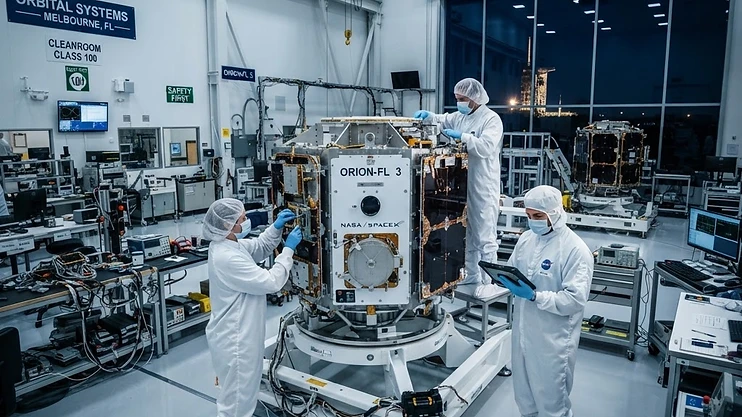
Argotec is a strong indicator of the gravitational pull to the Space Coast.
The landscape of Melbourne, Florida, is undergoing a profound transformation that extends far beyond the roar of rocket engines at the nearby Kennedy Space Center. While the region has long been defined by its proximity to the launch pad, a new industrial reality is taking hold: the transition from a transient launch site to a permanent, high-tech manufacturing powerhouse. This shift is not merely academic; it is a structural realignment of the regional economy, driven by a surge in private capital and a deliberate strategy to capture the entire aerospace value chain within the borders of Brevard County.
What happened
In April 2026, the Economic Development Commission of Florida’s Space Coast officially welcomed Argotec, an Italian aerospace leader, to its new U.S.-based satellite production facility in Melbourne. This move represents a significant milestone in the region's evolution. Argotec’s decision to establish its first U.S. production hub here is not an isolated event but part of a broader trend of international and domestic firms seeking proximity to the high-frequency launch cadence of the Space Coast. With over 109 launches recorded in 2025 and a robust pipeline of aerospace projects valued at $6 billion, the region has become a gravitational center for companies that need to move from design to orbit with unprecedented speed. The facility in Melbourne is designed to support rapid, scalable satellite delivery, catering to both U.S. government contracts and commercial missions. This follows a pattern of expansion seen across the region, including the recent arrival of Dassault Aviation and the growth of companies like Assured Space, which is bringing over 200 jobs focused on advanced radar and 5G technology to the Melbourne area. These investments are supported by state-level initiatives, such as the $38.5 million in funding recommended by Governor Ron DeSantis for Space Florida in 2026, aimed at bolstering infrastructure and tax incentives for space, defense, and semiconductor businesses.
Why it matters
This transition matters because it fundamentally changes the economic resilience of Melbourne and the surrounding Viera area. Historically, the Space Coast was vulnerable to the boom-and-bust cycles of government-led space programs. By anchoring manufacturing, radar development, and satellite assembly locally, the region is building a diversified industrial base that can survive shifts in federal spending. The presence of companies like Argotec creates a 'cluster effect'—a self-reinforcing cycle where specialized talent, supply chain vendors, and research institutions like Florida Tech converge. In two to three years, we expect to see a mature ecosystem where the 'time-to-orbit' for a new satellite is measured in weeks rather than months, because the entire lifecycle—from component fabrication in a Melbourne cleanroom to integration at the Launch and Landing Facility—happens within a 30-mile radius. This creates a structural advantage that is nearly impossible for other regions to replicate, effectively turning the Space Coast into the 'Silicon Valley of Space.'
The breakdown
- Supply chain localization: By bringing satellite production to Melbourne, companies are drastically reducing the logistical friction of shipping sensitive hardware across the country. This proximity allows for real-time engineering adjustments during the integration phase, which is critical for complex satellite missions.
- Talent migration: The influx of high-tech firms is creating a massive demand for specialized aerospace engineers and technicians, drawing top-tier talent to the Viera and Melbourne suburbs. This is forcing local educational institutions to accelerate their curriculum development to meet the specific needs of these new employers.
- Infrastructure investment: The state’s commitment to wastewater capacity and launch infrastructure is a direct response to the needs of these manufacturers. Without these utility upgrades, the rapid scaling of production facilities would be physically constrained by local resource limits.
- Defense and commercial synergy: The overlap between defense contractors and commercial space startups in Melbourne is creating a unique environment for dual-use technology development. This synergy is attracting venture capital that is increasingly interested in the intersection of 5G, radar, and satellite communications.
- Tax policy as a catalyst: The proposed tax exemptions for space and defense businesses are effectively lowering the barrier to entry for international firms. This policy is a key differentiator that allows Florida to compete with traditional aerospace hubs in California and Texas.
- The 'Launch-to-Manufacture' pipeline: The ability to test and launch hardware at the Kennedy Space Center while manufacturing it in Melbourne creates a feedback loop that accelerates innovation. This is a competitive advantage that no other region in the world can currently match.
- Economic diversification: By moving beyond just 'launch services,' the region is insulating itself from the volatility of the launch market. This shift ensures that even if launch demand fluctuates, the manufacturing and R&D sectors remain stable pillars of the local economy.
Key takeaways
- Melbourne is evolving from a launch site into a comprehensive aerospace manufacturing hub.
- International firms like Argotec are choosing the Space Coast to shorten their supply chains and access high-frequency launch capabilities.
- State-level funding and tax incentives are critical to maintaining the region's competitive edge against other aerospace hubs.
- The 'cluster effect' is creating a self-sustaining ecosystem of talent and infrastructure that will define the region's growth for the next decade.
Our view
Most coverage of the Space Coast focuses on the spectacle of the rocket launch, but the real story is the quiet, industrial transformation happening in the business parks of Melbourne and Viera. We believe that the 'launch-centric' narrative is outdated. The true winners in this new era will be the companies that master the integration of manufacturing and launch. We expect to see a wave of consolidation where smaller, specialized component manufacturers are acquired by larger integrators looking to secure their supply chains. The biggest risk to this growth is not a lack of demand, but a lack of infrastructure—specifically, the ability of local utilities to keep pace with the rapid industrial expansion. If the region fails to solve its wastewater and power capacity issues, it will hit a growth ceiling. However, given the current political momentum and the clear economic incentives, we are bullish on the region's ability to overcome these hurdles. The Space Coast is not just a place where rockets go up; it is becoming the place where the future of the space economy is built.
What to do about it
- For local business leaders: Evaluate your supply chain to see if you can pivot to support the aerospace manufacturing sector. The demand for specialized machining, cleanroom services, and logistics is at an all-time high.
- For technical talent: Focus on cross-disciplinary skills that bridge the gap between software, 5G, and hardware engineering. The most valuable employees in Melbourne today are those who understand how to integrate these technologies into satellite systems.
- For policymakers: Prioritize the expansion of utility infrastructure in the Viera and Melbourne industrial corridors. The current pace of industrial growth is unsustainable without significant upgrades to water and power capacity.
- For investors: Look for startups that are solving the 'last mile' of space manufacturing—specifically, companies that provide modular, scalable solutions for satellite integration and testing.
The bottom line
The transformation of Melbourne into a global satellite manufacturing hub is a testament to the power of strategic industrial policy and geographic advantage. By successfully integrating the entire aerospace value chain, the region has secured its position as the premier destination for the next generation of space technology. As more companies follow the path of Argotec and others, the Space Coast will continue to redefine what is possible in the commercial space sector. The future of the industry is being written in the cleanrooms of Florida, and the impact on the local economy will be felt for generations to come.