


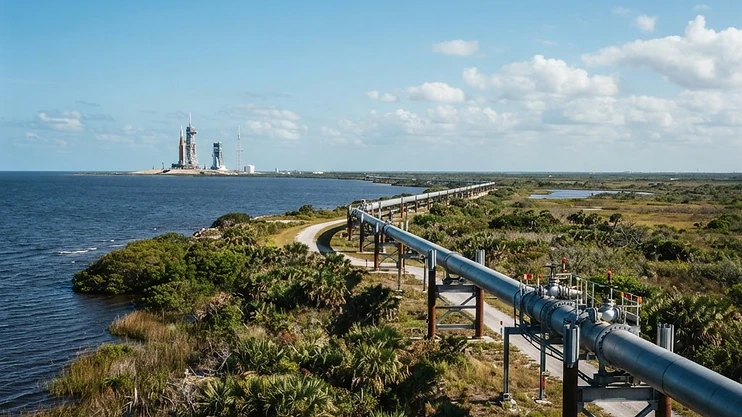
This is no longer just a matter of traffic management; it is a fundamental bottleneck in the industrialization of low-Earth orbit.
The sight of hundreds of tanker trucks clogging the arteries of the Space Coast has long been the accepted tax of the modern space race. As launch cadences accelerate toward the impossible, the logistical friction of moving cryogenic propellants by road has reached a breaking point. This is no longer just a matter of traffic management; it is a fundamental bottleneck in the industrialization of low-Earth orbit that threatens to stall the ambitions of the most aggressive players in the aerospace sector.
In a move that signals the transition of the Space Coast from a launch site to a permanent industrial zone, SpaceX has partnered with Florida Gas Transmission to construct a 32.4-mile, 16-inch steel pipeline directly into Cape Canaveral. This infrastructure project, slated for completion by August 2027, represents a shift in how we conceive of spaceport operations. By moving away from the '600-truck problem' per launch, the region is effectively treating rocket propellant as a utility, much like water or electricity, rather than a specialized cargo.
This development is the clearest indicator yet that the Space Coast is moving beyond the experimental phase of the 2010s and into a period of sustained, high-volume manufacturing and launch operations. For the residents of Melbourne, Viera, and the surrounding communities, this means the aerospace industry is becoming deeply embedded in the physical landscape of the county. The implications for local infrastructure, labor demand, and the broader regional economy are profound, marking a permanent change in the character of Florida’s eastern seaboard.
What happened
On October 8, 2026, reports confirmed that SpaceX is moving forward with a massive infrastructure project to support its Starship program. The plan involves a 32.4-mile pipeline designed to deliver natural gas directly to the launch site, bypassing the current reliance on a fleet of trucks that has become a logistical nightmare for local authorities and the company alike. The Brevard County Commission and local stakeholders have signaled support for the project, recognizing that the current model of transporting fuel is unsustainable as launch frequencies increase.
This project is part of a broader trend of capital-intensive infrastructure investment on the Space Coast. While Blue Origin is pouring $600 million into its 'Project Horizon' facility on Merritt Island to boost New Glenn production, SpaceX is focusing on the 'plumbing' of the launch site. The pipeline is not merely a convenience; it is a prerequisite for the high-cadence launch schedule required to support the Starship’s role in deep-space exploration and satellite deployment. By integrating the launch site into the regional energy grid, SpaceX is effectively creating a 'space-industrial' zone that functions with the efficiency of a modern refinery.
This follows a series of aggressive expansions in the region. With Relativity Space announcing plans for thousands of new jobs and the Space Coast Innovation Park breaking ground in Titusville, the demand for industrial capacity is at an all-time high. The pipeline project is the latest in a string of developments that have seen the Space Coast evolve from a NASA-centric hub into a multi-tenant, private-sector-led aerospace powerhouse. The collaboration between private firms and state entities like Space Florida has created a regulatory and physical environment where such massive infrastructure projects can move from concept to construction in record time.
Why it matters
The shift to pipeline-delivered propellant is a second-order consequence of the 'reusable rocket' revolution. When rockets were expendable, the cost of fuel was a rounding error compared to the cost of the hardware. Now that the hardware is reusable, the cost of operations—including the logistics of fueling—becomes the primary driver of launch economics. By eliminating the truck-based supply chain, SpaceX is lowering the marginal cost of every launch, which in turn makes the entire Starship ecosystem more competitive against traditional launch providers.
For the local economy in Melbourne and Viera, this signals a transition toward a more permanent, high-tech workforce. The construction of the pipeline itself is a massive civil engineering project, but the long-term impact is the stabilization of the aerospace sector. Companies are no longer just 'visiting' the Cape to launch; they are building permanent, integrated infrastructure that ties their success to the local geography. This creates a 'moat' around the Space Coast that is difficult for other regions to replicate, as the sheer scale of the infrastructure investment creates a barrier to entry for competitors.
In two to three years, we expect to see the Space Coast function as a fully integrated aerospace manufacturing and launch cluster. The pipeline will be the first of many 'utility-scale' projects that will define the region. We will likely see similar investments in power generation, water treatment, and specialized logistics hubs that cater specifically to the needs of the aerospace industry. This will drive further demand for high-skilled labor, pushing up wages and increasing the pressure on local housing and services, which will require proactive planning from local government.
The breakdown
- Logistical Efficiency: The pipeline eliminates the need for hundreds of fuel trucks per launch, drastically reducing traffic congestion on local roads and improving safety for the surrounding communities. This shift allows for a much higher launch cadence, as the fueling process becomes a continuous, automated operation rather than a manual, batch-based one.
- Industrial Integration: By treating propellant as a utility, SpaceX is aligning its launch operations with the standards of the petrochemical and energy industries. This integration makes the Cape a more efficient, predictable, and scalable environment for high-frequency aerospace operations.
- Regional Economic Stability: The investment in permanent infrastructure signals a long-term commitment from major aerospace players to the Space Coast. This reduces the risk of 'boom and bust' cycles, as companies are less likely to abandon facilities that are physically integrated into the regional energy grid.
- Supply Chain Maturation: The project highlights the growing sophistication of the local supply chain, which now includes large-scale civil engineering and energy infrastructure firms. This diversification of the local economy makes it more resilient to fluctuations in the aerospace market.
- Regulatory Cooperation: The support from the Brevard County Commission and state agencies demonstrates a high level of alignment between local government and the aerospace industry. This 'pro-growth' regulatory environment is a key competitive advantage for the Space Coast in attracting further investment.
- Competitive Advantage: The ability to launch at a higher frequency and lower cost than competitors is the ultimate goal of the Starship program. This infrastructure project is a critical component of that strategy, ensuring that the Cape remains the premier launch site in the world.
- Future-Proofing: As the space economy grows, the demand for energy and resources will only increase. By building this pipeline now, SpaceX is future-proofing its operations against potential supply chain disruptions and ensuring that it has the capacity to scale as needed.
Key takeaways
- The pipeline project marks a shift from 'truck-based' to 'utility-based' aerospace logistics.
- High-frequency launch schedules are now driving massive, permanent infrastructure investments on the Space Coast.
- Local government and private industry are increasingly aligned on large-scale, long-term capital projects.
- The Space Coast is evolving into a fully integrated, high-tech industrial cluster, not just a launch site.
- This infrastructure creates a significant competitive moat for companies operating out of Cape Canaveral.
Our view
Most coverage of the Space Coast focuses on the 'glamour' of the launches—the fire, the noise, and the spectacle. This misses the real story: the boring, industrial-scale infrastructure that is being built beneath the surface. The pipeline is a far more important development than any single launch, because it represents the 'industrialization' of space. We believe that the Space Coast is currently undergoing a transformation similar to the rise of the oil and gas hubs in the 20th century. The companies that win will be those that master the logistics of the ground, not just the physics of the sky.
Critics often worry about the environmental impact or the disruption to local life, but they fail to see that this infrastructure is actually a net positive for the region's long-term sustainability. By centralizing fuel delivery, we are reducing the carbon footprint of the launch process and making the entire operation safer. The real risk is not that we are building too much, but that we are not building fast enough to keep up with the pace of innovation. The Space Coast is becoming the 'Silicon Valley' of aerospace, and the infrastructure being built today will define the region for the next fifty years.
What to do about it
- For local businesses: Look for opportunities to provide support services for the massive civil engineering and maintenance projects that will follow this pipeline. The demand for specialized contractors, safety equipment, and logistics support will be significant.
- For investors: Focus on companies that are providing the 'picks and shovels' for the space industry—the firms that build the pipelines, the power grids, and the specialized manufacturing facilities that are becoming the backbone of the Space Coast.
- For policymakers: Continue to streamline the permitting process for critical infrastructure projects while ensuring that the local community is protected. The goal should be to maintain the 'pro-growth' environment while managing the inevitable growth in population and demand for services.
- For technical leaders: Consider how your own operations can benefit from the increasing availability of industrial-scale utilities on the Space Coast. The region is becoming an ideal location for companies that require high-energy, high-infrastructure environments.
The bottom line
The construction of the SpaceX pipeline is a watershed moment for the Space Coast, signaling the transition to a mature, industrial-scale aerospace economy. By treating propellant as a utility, the region is setting a new standard for launch efficiency and operational stability. This is not just about rockets; it is about the permanent integration of the space industry into the fabric of Brevard County. As we look toward 2027 and beyond, the infrastructure being built today will serve as the foundation for the next generation of space exploration and commercial activity.