


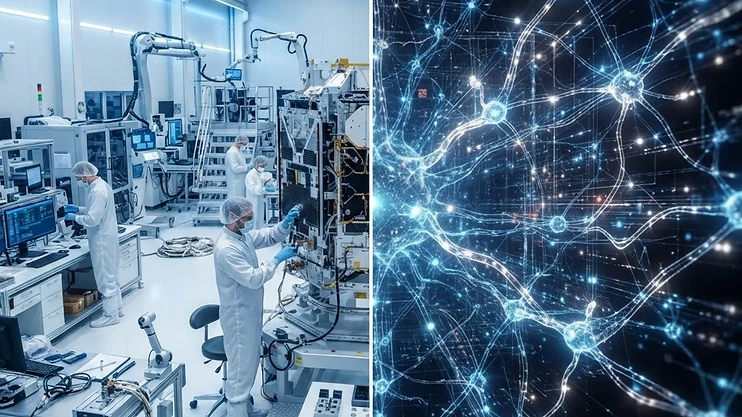
The challenge for Space Coast employers is to design AI systems that enhance human capability rather than replace it.
The integration of artificial intelligence into the aerospace and defense sectors is no longer a theoretical exercise; it is a daily reality for companies operating along the Space Coast. From the automated design processes at firms in Melbourne to the predictive maintenance systems used by launch providers, AI is fundamentally altering the nature of work. However, this transition is not without its challenges. Recent data suggests that while AI is not causing widespread job displacement, it is significantly changing the entry-level landscape, particularly for younger workers who are finding it harder to break into highly AI-exposed occupations.
For organizations in Melbourne, Viera, and the surrounding areas, this presents a unique paradox: how to leverage the efficiency gains of AI while simultaneously ensuring that the next generation of engineers and technicians gains the hands-on experience necessary to become the experts of tomorrow. The Space Coast, with its high concentration of aerospace and defense contractors, is at the epicenter of this shift. The decisions made by local leaders today regarding AI adoption and workforce development will determine whether the region remains a hub of innovation or becomes a victim of its own technological success.
This is not a call to slow down innovation, but rather a call to be intentional about how that innovation is implemented. The aerospace industry relies on a foundation of high-reliability, mission-critical work where the cost of failure is exceptionally high. In this environment, AI can be a powerful tool for augmentation, but it cannot replace the intuition and judgment that come from years of experience. The challenge for Space Coast employers is to design AI systems that enhance human capability rather than replace it, ensuring that the workforce remains resilient and adaptable in an increasingly automated world.
What happened
The Space Coast is currently navigating a complex workforce transition driven by the dual forces of massive aerospace expansion and the rapid adoption of AI. In May 2026, Blue Origin announced a $600 million expansion in the region, expected to support 500 new aerospace jobs. This was followed in August 2026 by the announcement of a $1.5 million NASA-backed workforce hub aimed at building technical talent in fields like cybersecurity, logistics, and advanced manufacturing. However, these positive developments are being tempered by concerns about the impact of AI on the workforce. Research from Stanford, updated in August 2026, indicates that employment among workers aged 22 to 25 in highly AI-exposed occupations is 19% lower than it would have been without the influence of AI. The researchers found that this is primarily due to reduced hiring rather than widespread displacement, suggesting that companies are becoming more selective about who they bring on board.
Local employers are now facing a critical decision: how to integrate AI into their workflows without hollowing out the entry-level positions that serve as the training ground for future experts. The Space Coast’s unique ecosystem—which includes major defense contractors, agile startups, and world-class research institutions like Florida Tech—is uniquely positioned to lead this transition. However, the warning from the Stanford data is clear: if companies do not intentionally design their AI adoption to support apprenticeship and skill development, they risk creating a long-term talent shortage. The current strategy, as evidenced by the new workforce hub, is to focus on high-skill training, but this must be balanced with a commitment to hiring and mentoring the next generation of professionals.
Why it matters
The deeper issue here is the preservation of institutional knowledge and the development of human expertise in an era of automation. In the aerospace industry, the 'tacit knowledge'—the things that engineers learn by doing, by seeing, and by failing—is the most valuable asset a company has. If AI is used to automate the tasks that provide this experience, we risk creating a generation of workers who are proficient at using tools but lack the deep understanding of the underlying systems. This is a structural risk that could have profound consequences for the safety and reliability of the aerospace systems that the Space Coast is famous for.
For the local economy, this means that the 'war for talent' will only intensify. Companies that can successfully integrate AI while maintaining a robust mentorship and apprenticeship program will have a significant competitive advantage. They will be able to attract the best young talent, who are looking for opportunities to learn and grow, rather than just being a cog in an automated machine. Conversely, companies that rely too heavily on AI to replace entry-level roles will find themselves with a 'hollowed-out' workforce, lacking the depth of experience needed to solve complex, novel problems. This is not just a human resources issue; it is a strategic imperative that will define the long-term viability of the Space Coast’s aerospace cluster.
In the next two to three years, we expect to see a bifurcation in the market. Some companies will double down on AI-driven efficiency, potentially seeing short-term gains but long-term stagnation in innovation. Others will adopt a 'human-in-the-loop' approach, using AI to accelerate the learning curve for new employees. The latter group will be the ones that thrive, as they will be able to innovate faster and more reliably than their competitors. The Space Coast has the opportunity to set the standard for how this transition should be managed, but it requires a shift in mindset from viewing AI as a cost-saving tool to viewing it as a force multiplier for human potential.
The breakdown
-
The apprenticeship gap: AI is currently reducing the number of entry-level roles available, which is where the most critical learning happens. Without these roles, the pipeline for future senior engineers and technicians is being constricted. Companies must find ways to maintain these positions, perhaps by redefining them as 'AI-augmented' roles that focus on higher-level problem solving from day one.
-
Tacit knowledge preservation: The most important skills in aerospace are often learned through experience, not through formal training. AI can document processes, but it cannot replicate the intuition that comes from years of working on the factory floor or the flight line. Employers must prioritize mentorship programs that pair experienced veterans with new hires, using AI to facilitate, not replace, these interactions.
-
The 'human-in-the-loop' imperative: In mission-critical industries, AI should always be used to augment human decision-making, not to replace it. This requires a culture of accountability where humans are always responsible for the final output. This approach not only ensures safety but also keeps the human workforce engaged and responsible for the outcomes of their work.
-
Workforce hub potential: The $1.5 million NASA-backed workforce hub is a critical piece of the puzzle, but it must be focused on more than just technical skills. It needs to emphasize the 'soft skills' of engineering—critical thinking, problem-solving, and collaboration—that AI cannot easily replicate. This will ensure that the local workforce remains adaptable to the changing technological landscape.
-
Competitive advantage through culture: Companies that can offer a clear path for growth and development in an AI-driven world will win the war for talent. This means creating a culture that values continuous learning and provides employees with the tools and time to master their craft. This is a significant differentiator in a market where many companies are focused solely on short-term efficiency.
-
The risk of stagnation: If companies rely too heavily on AI, they risk losing the ability to innovate. Innovation often comes from the 'fringe'—the unexpected insights that come from human creativity and experimentation. By automating too much, companies risk creating a rigid, predictable environment that is incapable of producing the next generation of aerospace breakthroughs.
-
Strategic AI adoption: AI adoption should be driven by business strategy, not just by the availability of new tools. Companies need to be clear about what they are trying to achieve—whether it’s faster design cycles, better predictive maintenance, or improved safety—and then select the AI tools that best support those goals. This requires a disciplined approach that keeps the human element at the center of the strategy.
Key takeaways
- AI is not causing mass displacement, but it is significantly reducing entry-level hiring in the aerospace sector.
- The loss of entry-level roles threatens the long-term development of human expertise and institutional knowledge.
- Companies must adopt a 'human-in-the-loop' strategy to ensure safety and maintain the ability to innovate.
- Mentorship and apprenticeship programs are more important than ever to bridge the gap between AI-driven efficiency and human experience.
- The Space Coast’s long-term success depends on its ability to cultivate a workforce that is both technically proficient and capable of deep, creative problem-solving.
Our view
Most coverage of the AI workforce issue focuses on the fear of job loss, but that is the wrong framing. The real danger is not that AI will replace workers, but that it will make them less capable by removing the 'struggle' of learning. We believe that the companies that win on the Space Coast will be the ones that treat AI as a tool for 'accelerated apprenticeship.' Instead of using AI to do the work of a junior engineer, they should use it to provide that engineer with the data, simulations, and feedback they need to learn twice as fast. The companies that try to use AI to cut costs by eliminating entry-level roles will find themselves in a crisis in five years when they realize they have no one left who knows how to solve the hard problems. The $1.5 million workforce hub is a great start, but it needs to be paired with a radical change in how local companies approach hiring and training. We expect to see a 'talent premium' emerge for companies that can demonstrate a commitment to human-centric AI adoption. Those who ignore this will find themselves unable to compete for the best talent, and eventually, unable to compete in the market. The most successful leaders will be those who can articulate a vision where AI and human expertise are not in competition, but in a powerful, symbiotic relationship.
What to do about it
- For HR and hiring managers: Re-evaluate your hiring criteria to prioritize potential and adaptability over immediate technical proficiency, and invest in internal training programs that leverage AI to accelerate the onboarding process.
- For engineering leads: Design your workflows to ensure that junior staff are still getting hands-on experience, even if AI is handling the routine parts of the job. Use AI to provide them with more complex, challenging problems earlier in their careers.
- For business owners: Shift your focus from 'AI-driven cost reduction' to 'AI-driven capability enhancement.' Measure the success of your AI adoption by how much it improves the productivity and creativity of your human workforce, not just by how many hours it saves.
- For educators and training providers: Partner with local industry to ensure that your curriculum is not just teaching the latest tools, but is also fostering the critical thinking and problem-solving skills that will remain relevant regardless of how AI evolves.
The bottom line
The AI workforce paradox is the defining challenge for the Space Coast’s next decade of growth. By intentionally designing AI systems that augment rather than replace human expertise, local companies can build a more resilient and innovative workforce. The future of the aerospace industry will not be won by the company with the most advanced AI, but by the company that best integrates that AI into a culture of human excellence. The choices made today will determine whether the region remains a global leader or falls behind in the race for talent and innovation.