


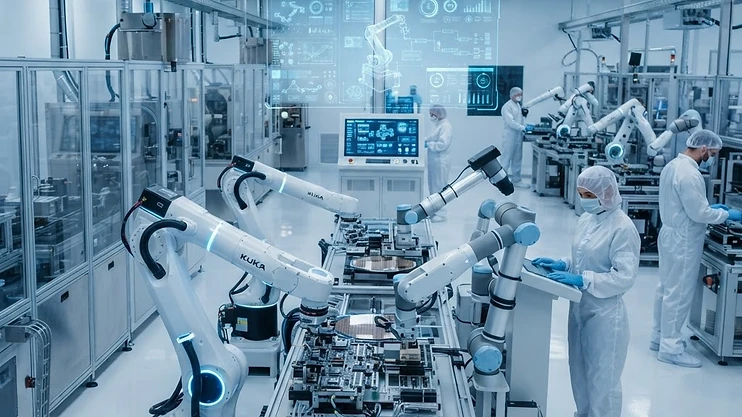
The future of industrial AI will be won by the systems that can pass the audit.
The narrative surrounding Artificial Intelligence has been dominated by large language models and consumer-facing chatbots, but a quieter, more consequential revolution is taking place in the industrial heartlands of Florida. In Brevard County, a new generation of leaders is applying AI to the most demanding environments imaginable: nondestructive testing, leak detection, and high-precision manufacturing. This is not the 'move fast and break things' culture of Silicon Valley; it is a 'move carefully and verify everything' approach that is essential for the aerospace and defense sectors that define the Space Coast.
Aaron Sneed, the President of Leak Testing Specialists (LTS), represents this new breed of industrial technologist. By integrating AI into the rigorous, highly regulated world of nondestructive testing, Sneed is demonstrating that the true potential of AI lies in its ability to provide better evidence and eliminate blind spots in high-consequence work. This shift is critical for the Space Coast, where the margin for error is zero and the cost of failure is measured in millions of dollars and human lives.
As global supply chains face increasing pressure to reshore and modernize, the lessons being learned in Melbourne and Palm Bay are becoming a blueprint for the rest of the country. The integration of AI into industrial workflows is not just about efficiency; it is about creating a verifiable, audit-ready system that can meet the stringent requirements of government and commercial aerospace contracts. This is the future of manufacturing, and it is being built right here on the Space Coast.
What happened
On February 16, 2026, Aaron Sneed took the helm of Leak Testing Specialists (LTS) in Brevard County, signaling a strategic pivot toward the integration of advanced AI in industrial testing. LTS, a long-standing player in the nondestructive testing (NDT) market, has begun deploying AI-driven systems to enhance the accuracy and reliability of its testing protocols. This move is part of a broader trend on the Space Coast where companies are moving away from purely manual, labor-intensive processes toward AI-augmented workflows. Sneed has been vocal about the need for 'regulated manufacturing' and the importance of reshoring, arguing that the future of industrial AI will be won by systems that can pass the audit, not just those that look good in a demo. This philosophy is gaining traction among other local firms, including those in the satellite and defense sectors, who are increasingly looking for ways to automate quality control without sacrificing the rigorous documentation required by federal regulators. The result is a growing ecosystem of companies that are blending traditional engineering expertise with cutting-edge machine learning, creating a unique competitive advantage for the region.
Why it matters
The deeper significance of this trend lies in the structural change it brings to the manufacturing sector. For decades, the 'black box' nature of AI has been a barrier to its adoption in high-consequence industries. By focusing on auditability and evidence-based AI, companies like LTS are breaking down that barrier. This has second-order consequences for the entire supply chain: when testing becomes faster and more reliable, the entire production cycle accelerates. This is a massive competitive advantage for the Space Coast, as it allows local firms to deliver high-quality components to companies like SpaceX, Blue Origin, and the Department of Defense with greater speed and lower risk. In 2-3 years, we expect to see a 'Space Coast Standard' for industrial AI, where the ability to provide AI-verified, audit-ready data becomes a prerequisite for doing business in the aerospace sector. This will force competitors in other regions to play catch-up, effectively creating a moat around the local manufacturing base. Furthermore, this shift will attract more high-tech talent to the area, as engineers and data scientists realize that the most interesting, high-stakes work is happening in the industrial labs of Melbourne and Palm Bay, not just in the software hubs of the West Coast.
The breakdown
- Audit-Ready AI: The core innovation is the development of AI systems that provide a clear, traceable audit trail for every decision they make. This is essential for industries where safety and compliance are non-negotiable, such as aerospace and defense.
- Nondestructive Testing (NDT) Evolution: By applying AI to NDT, companies can detect microscopic flaws in materials that would be invisible to the human eye or traditional testing methods. This significantly increases the reliability of critical components used in space flight.
- Reshoring and Supply Chain Security: The focus on local, AI-augmented manufacturing is a direct response to the need for more secure and resilient supply chains. By keeping production and testing local, companies can better control quality and protect intellectual property.
- High-Consequence Decision Support: AI is being used as a tool to augment human expertise, not replace it. By providing technicians with better data and fewer blind spots, these systems allow for more informed decision-making in high-pressure environments.
- Regulatory Alignment: The success of these companies depends on their ability to work closely with regulators to ensure that AI-driven processes meet or exceed existing safety standards. This proactive approach is a key differentiator for Space Coast firms.
- Talent Attraction: The combination of high-stakes engineering and advanced AI is attracting a new generation of talent to the region. This is creating a vibrant, interdisciplinary community that is pushing the boundaries of what is possible in industrial manufacturing.
- Scalability of Quality Control: As the demand for space hardware grows, the ability to scale quality control without increasing headcount is critical. AI-driven testing allows companies to maintain high standards while significantly increasing their throughput.
Key takeaways
- Industrial AI is moving from hype to high-consequence, audit-ready applications on the Space Coast.
- The ability to provide verifiable, evidence-based AI data is the new competitive standard for aerospace suppliers.
- Local firms are successfully blending traditional engineering with machine learning to solve complex, high-stakes problems.
- This shift is a key driver for the reshoring of critical manufacturing and the strengthening of local supply chains.
- The Space Coast is becoming a global leader in the practical, industrial application of AI.
Our view
Most of the current discourse around AI is focused on the wrong things: generative models, creative writing, and consumer convenience. The real, transformative power of AI is in the physical world, specifically in the 'boring' but essential tasks of quality control, testing, and maintenance. What Aaron Sneed and others on the Space Coast are doing is far more important than the latest chatbot release. They are building the infrastructure of trust that will allow AI to be used in the most critical systems on the planet. We believe that the companies that master 'audit-ready AI' will dominate the industrial sector for the next twenty years. Most coverage of this story gets it wrong by focusing on the 'AI' part of the equation, when they should be focusing on the 'industrial' part. The winners will not be the companies with the most powerful models, but the ones that can integrate those models into existing, highly regulated workflows without breaking them. This is a massive opportunity for the Space Coast to define the global standard for industrial AI, and we expect to see a wave of investment and talent flowing into the region as a result. The 'move fast and break things' era is over; the era of 'move carefully and verify everything' has begun, and it is being led by the engineers of Brevard County.
What to do about it
- Prioritize Auditability: If you are implementing AI in your operations, ensure that your systems are designed to provide a clear, traceable audit trail for every decision, especially in high-consequence environments.
- Focus on Augmentation: Use AI as a tool to support your human experts, not to replace them. The goal should be to provide your team with better data and fewer blind spots, not to automate away their expertise.
- Engage with Regulators: Be proactive in working with industry regulators to ensure that your AI-driven processes meet or exceed existing safety and quality standards.
- Invest in Data Quality: The effectiveness of your AI is only as good as the data it is trained on. Invest in high-quality, reliable data collection and management systems to ensure your AI is providing accurate and actionable insights.
The bottom line
The integration of AI into the industrial heart of the Space Coast is a clear signal that the region is at the forefront of the next manufacturing revolution. By focusing on auditability, safety, and high-consequence applications, local leaders are setting a new standard for the entire industry. This is not just about technology; it is about building a more resilient, reliable, and secure future for American manufacturing. The Space Coast is proving that the most advanced AI is the kind that works in the real world, where the stakes are high and the results must be perfect.