


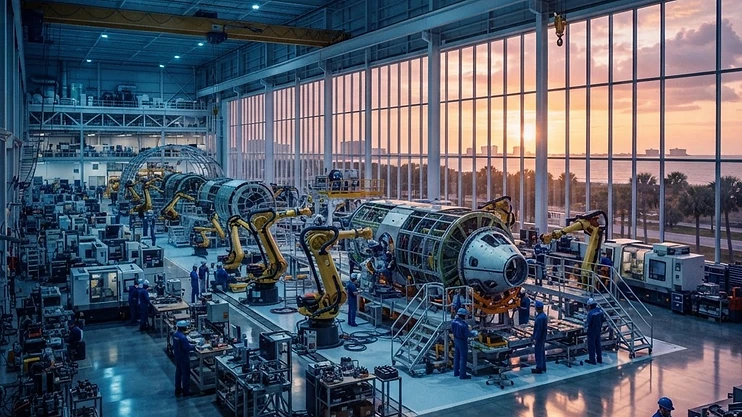
The landscape of Florida’s Space Coast is undergoing a structural transformation that transcends the typical cadence of launch-and-land operations.
The landscape of Florida’s Space Coast is undergoing a structural transformation that transcends the typical cadence of launch-and-land operations. With Relativity Space announcing a massive expansion expected to create thousands of high-paying jobs by 2034, the region is pivoting from a transient testing ground into a permanent, vertically integrated manufacturing powerhouse. This shift is not merely about more rockets; it is about the consolidation of a localized supply chain that anchors the global aerospace economy directly into the soil of Melbourne and its surrounding corridors.
This development arrives at a critical juncture where the sheer volume of orbital activity—surpassing triple-digit launches in 2025—has necessitated a move toward industrial-scale production. As companies like Relativity Space commit to long-term infrastructure, the local ecosystem is evolving to support a permanent workforce that requires more than just launch pads; it requires advanced manufacturing facilities, specialized logistics, and a deep bench of engineering talent. The implications for the Space Coast are profound, signaling a transition from a government-led space program to a private-sector-dominated industrial engine.
For business leaders in Melbourne, Viera, and the broader Brevard County area, this represents a fundamental change in the regional value proposition. The influx of capital and human resources is creating a gravitational pull that is attracting secondary and tertiary suppliers, effectively insulating the local economy from the volatility of individual launch schedules. As we look toward the next decade, the Space Coast is no longer just a place where things go up; it is becoming the primary location where the future of aerospace is built, tested, and scaled for global deployment.
What happened
In July 2026, Relativity Space confirmed a major expansion plan on Florida’s Space Coast, a move that promises to inject thousands of high-paying jobs into the local economy over the next eight years. This expansion is part of a broader trend of private aerospace investment that has seen over $3.3 billion in private capital flow into the Brevard County region in recent years. The announcement follows a series of strategic investments, including a $15 million grant awarded to the Space Coast Regional Airport in Titusville earlier in 2026 to bolster infrastructure, ensuring that the region can handle the increased logistical demands of a growing aerospace sector.
Space Florida, the state’s aerospace economic development agency, has been instrumental in facilitating these moves. President and CEO Rob Long has emphasized that the current strategy is to connect Florida-based companies with international partners, effectively turning the Space Coast into a global nexus for aerospace innovation. This is further supported by the Florida International Aerospace Innovation Fund, which recently committed $400,000 to collaborative projects. The expansion of Relativity Space is not an isolated event but a component of a larger, state-backed effort to solidify Florida’s dominance in the global launch market, which is currently experiencing phenomenal growth.
Local companies are already responding to this momentum. Extant Aerospace, a long-standing fixture in the Melbourne aerospace community, recently broke ground on a new state-of-the-art manufacturing facility in the city. This facility is designed to support the production and repair of over 5,000 part numbers, highlighting the shift toward localized, high-volume manufacturing. The Economic Development Commission (EDC) of Florida’s Space Coast has noted that these expansions are driven by the availability of a highly skilled local workforce, which remains the region’s most significant competitive advantage in the face of increasing competition from other states.
Why it matters
The structural shift toward permanent, high-scale manufacturing on the Space Coast changes the economic calculus for the entire region. Historically, the aerospace industry in Brevard County was characterized by cyclical, project-based work tied to specific NASA or Department of Defense contracts. The current influx of private capital and the establishment of permanent manufacturing facilities like those of Relativity Space and Extant Aerospace create a more stable, diversified economic base. This stability is crucial for long-term regional planning, as it allows for the development of specialized infrastructure that can support multiple companies simultaneously.
From a competitive standpoint, this consolidation makes it increasingly difficult for other regions to replicate the Space Coast’s success. The combination of existing launch infrastructure, a growing pool of specialized labor, and state-level support through entities like Space Florida creates a 'moat' that is difficult to cross. In two to three years, we expect to see a significant increase in the density of the supply chain, with smaller, specialized firms clustering around these larger anchors. This clustering effect will likely lead to increased innovation, as the proximity of engineers, manufacturers, and logistics providers facilitates faster iteration cycles.
Furthermore, the global aerospace market is increasingly looking to the Space Coast as a primary hub for international collaboration. By positioning the region as a gateway for global aerospace partnerships, Florida is effectively capturing a larger share of the international space economy. This has second-order consequences for local businesses, as the demand for high-tech services, cybersecurity, and cloud infrastructure will grow in tandem with the physical manufacturing footprint. Organizations that can integrate themselves into this supply chain now will be well-positioned to capture the value generated by this long-term industrial expansion.
The breakdown
- Vertical integration of the supply chain: The arrival of large-scale manufacturers like Relativity Space necessitates a robust local ecosystem of suppliers, ranging from precision machining to advanced materials science. This creates a self-sustaining loop where the presence of major players attracts smaller, specialized firms, further deepening the regional talent pool and technical capabilities.
- Infrastructure as a competitive advantage: The $15 million grant for the Space Coast Regional Airport and other state-funded improvements are not just maintenance; they are strategic investments in logistics. By upgrading facilities to handle the transport of large-scale aerospace components, the region is removing bottlenecks that could otherwise stifle growth and drive companies to look elsewhere.
- The role of Space Florida as a catalyst: Space Florida’s strategy of connecting local firms with international partners is a sophisticated approach to economic development. By leveraging the state’s existing aerospace advantages to attract global investment, they are ensuring that the Space Coast remains relevant even as the global space market becomes more crowded and competitive.
- Workforce development and academic alignment: The expansion of the Florida University Space Research Consortium to include institutions like Florida Tech and FIU is critical for sustaining this growth. By aligning academic research with the needs of the private sector, the region is ensuring a steady pipeline of engineers and technicians who are trained on the latest technologies and methodologies.
- Shift from government-led to private-sector-led: The transition from NASA-centric operations to a private-sector-dominated landscape changes the nature of risk and reward in the region. While this introduces more market-driven volatility, it also allows for faster innovation and a more agile response to global demand, which is essential for maintaining a competitive edge.
- Geographic clustering in Melbourne and Viera: The concentration of new facilities in Melbourne and the surrounding areas is creating a high-tech corridor that benefits from shared resources and proximity. This geographic density is a key factor in attracting top-tier talent, who are increasingly looking for regions that offer both professional opportunities and a high quality of life.
- Long-term economic stability: By moving toward a model of permanent manufacturing, the Space Coast is insulating itself from the boom-and-bust cycles of the past. This stability is attracting institutional investors and long-term capital, which in turn fuels further infrastructure development and creates a virtuous cycle of growth that is likely to persist for the next decade.
Key takeaways
- The Space Coast is transitioning from a launch-focused region to a permanent, high-scale aerospace manufacturing hub.
- Private investment is now the primary driver of growth, with billions in capital flowing into the region to support long-term infrastructure.
- Local companies like Extant Aerospace are expanding their footprint, signaling confidence in the region’s skilled labor market.
- State-level initiatives are successfully positioning the region as a global nexus for international aerospace partnerships.
- The clustering of aerospace firms in Melbourne and Viera is creating a resilient, high-tech ecosystem that is difficult for competitors to replicate.
Our view
Most coverage of the Space Coast focuses on the spectacle of rocket launches, but the real story is the quiet, industrial-scale build-out happening in the warehouses and manufacturing plants of Melbourne and Titusville. We believe that the region is currently in the early stages of a 'Space Industrial Revolution' that will define the next twenty years of the local economy. The most significant error in current analysis is the assumption that this growth is purely dependent on launch frequency; in reality, it is dependent on the manufacturing and supply chain infrastructure that supports those launches.
We expect that in the coming years, the Space Coast will become the primary global center for aerospace manufacturing, effectively displacing older, less agile hubs. The winners in this transition will be the companies that can successfully integrate into this new, dense supply chain. Those that continue to view the region through the lens of traditional government contracting will find themselves increasingly marginalized. The real opportunity lies in the 'picks and shovels' of this new space economy—the software, the specialized manufacturing, and the logistics services that will be required to keep this massive industrial engine running. The Space Coast is no longer a place to visit for a launch; it is the place where the future of the industry is being manufactured.
What to do about it
- Audit your supply chain integration: If your business operates in the aerospace or defense sector, evaluate how your current operations align with the growing manufacturing hubs in Melbourne and Viera. Identify opportunities to provide specialized services or components to the larger anchor firms that are currently expanding in the region.
- Invest in local talent pipelines: Partner with local universities like Florida Tech to create internship and training programs that are specifically tailored to the needs of the modern aerospace industry. This will ensure that your organization has access to the specialized skills required to compete in this high-growth environment.
- Leverage state-level resources: Engage with Space Florida and the Economic Development Commission of Florida’s Space Coast to understand the available grants, incentives, and partnership opportunities. These organizations are actively looking to connect local businesses with global partners, and proactive engagement can provide a significant competitive advantage.
- Focus on digital infrastructure: As manufacturing becomes more automated and data-driven, ensure that your organization’s cloud and network infrastructure is capable of supporting high-bandwidth, low-latency operations. The future of aerospace manufacturing is digital, and your IT capabilities must keep pace with your physical production capacity.
The bottom line
The Space Coast is undergoing a fundamental shift that is cementing its status as the premier aerospace manufacturing hub in the United States. With massive private investment and a clear, state-backed strategy, the region is building a permanent industrial foundation that will support the next generation of space exploration. For businesses in Melbourne and the surrounding areas, this represents a unique opportunity to participate in a high-growth, high-tech ecosystem. The transition from a launch-centric model to a manufacturing-centric one is not just a change in operations; it is a change in the very identity of the region. Those who recognize this shift and align their strategies accordingly will be the ones to thrive in this new era of space-based industrialization.