


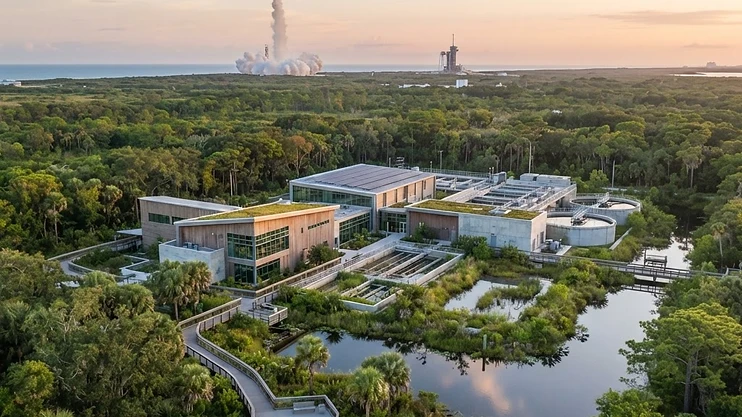
The proposed $5 million in startup funding for Space Florida to address wastewater capacity is not just a line item in a budget; it is the most critical infrastructure investment currently being made in the region.
When we talk about the 'Space Coast,' we often focus on the rockets, the satellites, and the sheer velocity of innovation. But the true constraint on the region's growth is far more mundane: wastewater. As launch providers like Blue Origin and SpaceX expand their footprints, the demand for industrial-grade water treatment has skyrocketed. The proposed $5 million in startup funding for Space Florida to address wastewater capacity is not just a line item in a budget; it is the most critical infrastructure investment currently being made in the region. Without this capacity, the ambitious launch schedules that define the Space Coast would grind to a halt.
This is the reality of scaling a high-tech industrial hub in a sensitive environmental zone. The Indian River Lagoon, a jewel of the region, cannot be sacrificed for the sake of progress. Therefore, the challenge is to develop innovative, small-scale water treatment technologies that can handle the specific waste streams of aerospace manufacturing without compromising the local ecosystem. This is where the intersection of environmental policy and industrial engineering becomes the most important story in the region.
For businesses in Melbourne, Viera, and Titusville, this is a wake-up call. The infrastructure that supports your operations is not just the power grid or the internet; it is the entire environmental management system. As the region continues to grow, the companies that will thrive are those that can integrate sustainable practices into their core operations. This is the new standard for the Space Coast, and it is a standard that will define the next decade of growth.
What happened
In late 2025 and early 2026, the issue of wastewater capacity became a central focus for the Economic Development Commission of Florida’s Space Coast and Space Florida. With the record-breaking number of launches, the existing infrastructure was pushed to its limits. Gov. Ron DeSantis’s proposed budget for the 2026 fiscal year included $17.5 million for Space Florida, with $5 million specifically earmarked for wastewater capacity improvements to support commercial launch providers. This funding is intended to work alongside state agencies to establish additional capacity, addressing concerns raised by residents regarding the environmental impact of operations, such as those associated with Blue Origin’s draft permit renewal. The EDC has also partnered with the City of Titusville on a pilot project for small-scale, innovative water treatment technology in the Indian River Lagoon. These efforts represent a coordinated, multi-pronged approach to solving a critical infrastructure bottleneck that threatens to slow down the region's aerospace growth.
Why it matters
Infrastructure is the invisible hand that guides economic development. When that infrastructure fails, the entire system stalls. The wastewater issue is a perfect example of how a 'boring' utility can become a 'make-or-break' factor for a high-tech industry. If the Space Coast cannot manage the waste generated by its launch providers, it will lose its competitive advantage. Companies will look elsewhere, and the momentum that has been built over the last decade will dissipate. This is why the investment in wastewater capacity is so critical; it is an investment in the region's ability to continue to host the world's most advanced aerospace companies.
Furthermore, this challenge is an opportunity for innovation. By forcing the development of new, small-scale water treatment technologies, the Space Coast is creating a new market for environmental engineering. These technologies, once proven, can be exported to other regions facing similar challenges. This is the 'Space Coast effect'—where the demands of the aerospace industry drive innovation in other, seemingly unrelated fields. In two to three years, we expect to see a new cluster of environmental tech companies emerging in the region, specifically focused on solving the unique waste management challenges of high-tech manufacturing. This will diversify the local economy and make it more resilient to the fluctuations of the aerospace market.
The breakdown
- Infrastructure as a bottleneck: The rapid growth of the aerospace industry has outpaced the existing wastewater infrastructure, creating a critical constraint on future expansion.
- Environmental stewardship: The region’s commitment to protecting the Indian River Lagoon is non-negotiable. The challenge is to balance industrial growth with environmental preservation, which is driving the need for innovative solutions.
- Public-private collaboration: The partnership between Space Florida, the EDC, and local governments is essential for securing the funding and expertise needed to address these infrastructure challenges.
- Innovation in water treatment: The pilot projects for small-scale water treatment are not just solving a local problem; they are creating a new technological capability that can be applied elsewhere.
- Policy as an enabler: The state’s investment in wastewater capacity is a clear signal that Florida is committed to maintaining its status as the premier aerospace hub in the country.
- Addressing community concerns: By proactively addressing the environmental concerns of residents, the industry is building the trust necessary to continue its operations and expansion.
- Diversifying the economy: The focus on environmental technology is creating a new, high-growth sector that complements the existing aerospace industry, making the local economy more robust.
Key takeaways
- Wastewater capacity is the most critical infrastructure bottleneck currently facing the Space Coast’s aerospace industry.
- The state’s $5 million investment is a strategic move to ensure that the region can continue to support its record-breaking launch cadence.
- The challenge is driving innovation in small-scale, sustainable water treatment technologies.
- This is a prime example of how environmental stewardship can drive economic growth and technological innovation.
- The region is positioning itself as a leader in both aerospace and environmental engineering, creating a more diverse and resilient economy.
Our view
Most coverage of the Space Coast’s growth ignores the 'plumbing'—the wastewater, the power, the roads. That is a massive oversight. The real story of the next five years will not be the number of rockets launched, but the ability of the region to build the infrastructure that supports those launches. We believe that the investment in wastewater capacity is the most important decision made by the state this year. It shows a level of foresight that is rare in government. The winners are the companies that can operate within these new, more sustainable parameters; the losers are those that continue to view environmental compliance as a burden rather than an opportunity. The most common mistake is thinking that this is just a 'local issue.' It is a global issue, and the solutions developed here will be in high demand across the world as other regions struggle to balance industrial growth with environmental protection.
What to do about it
- For industrial leaders: Proactively invest in your own on-site water treatment capabilities to reduce your reliance on public infrastructure and to demonstrate your commitment to sustainability.
- For environmental tech startups: Look for opportunities to partner with the EDC and local governments to pilot your technologies in the Space Coast’s unique environment.
- For policymakers: Continue to prioritize infrastructure investments that support both industrial growth and environmental protection, as these are the foundations of a sustainable economy.
- For community members: Stay engaged in the planning process and hold both the industry and the government accountable for meeting the highest environmental standards.
The bottom line
The wastewater challenge is the ultimate test of the Space Coast’s maturity as an industrial hub. By investing in the necessary infrastructure and fostering innovation in environmental technology, the region is proving that it can handle the demands of the future. This is not just about keeping the launch pads running; it is about building a sustainable, resilient, and prosperous community. The Space Coast is showing the world that you don't have to choose between progress and the planet—you can have both, if you are willing to invest in the infrastructure of ambition.