


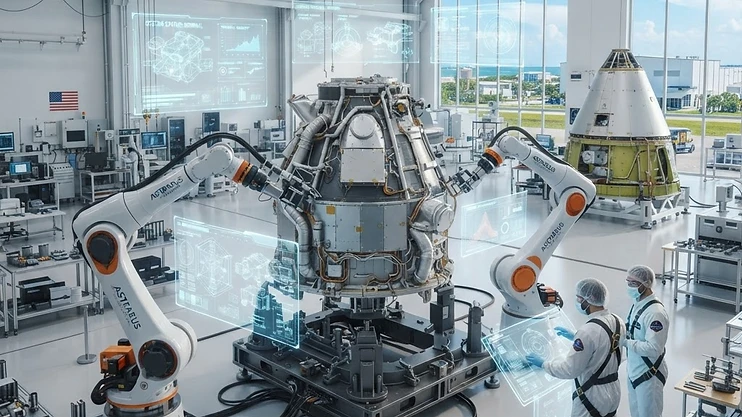
The manufacturing floor of the future is being built right here in Melbourne, Florida.
The manufacturing floor of the future is being built right here in Melbourne, Florida. As the aerospace industry faces unprecedented pressure to increase launch frequency and reduce costs, the traditional, manual-heavy manufacturing processes are being rapidly replaced by AI-driven, autonomous systems. This is not just about robots on an assembly line; it is about the integration of machine learning into the entire lifecycle of a spacecraft, from design optimization to predictive maintenance of launch hardware.
For local companies, the adoption of AI is no longer a competitive advantage—it is a requirement for survival. The ability to process the massive amounts of telemetry data generated during testing and flight, and to feed that data back into the manufacturing process in real-time, is the new gold standard. This shift is fundamentally changing the workforce requirements in the region, moving the demand from traditional mechanical engineering to a hybrid of software, data science, and aerospace engineering.
This article examines how the integration of AI is reshaping the local aerospace ecosystem, the challenges of implementing these technologies in a highly regulated environment, and what this means for the future of the Space Coast as a global hub for advanced manufacturing. We will look at how local firms are navigating the transition and the implications for the broader regional economy.
What happened
Over the past 18 months, we have seen a surge in AI adoption among aerospace contractors and startups in the Melbourne and Titusville areas. Companies are increasingly utilizing AI for 'digital twin' modeling, which allows them to simulate the performance of components under extreme conditions before they are ever manufactured. This has significantly reduced the time and cost of prototyping. Furthermore, the use of AI in supply chain management has become critical as firms deal with the complexities of sourcing specialized materials for space-grade hardware. By using predictive analytics, these companies are able to anticipate supply chain disruptions and adjust their production schedules accordingly. The integration of AI is also being seen in the maintenance of launch facilities, where sensors provide real-time data that AI models use to predict when a component is likely to fail, allowing for proactive maintenance rather than reactive repairs. This shift is supported by the local academic ecosystem, with Florida Tech playing a key role in training the next generation of engineers who are fluent in both aerospace and AI technologies.
Why it matters
The deeper significance of this shift is the democratization of high-end aerospace manufacturing. AI allows smaller, more agile firms to compete with established giants by reducing the overhead of traditional R&D. This is leading to a more vibrant and diverse aerospace ecosystem on the Space Coast. In 2-3 years, we expect to see a 'platformization' of aerospace manufacturing, where AI-driven design and production tools become the standard, lowering the barrier to entry for new players. This will likely lead to an explosion of innovation in the region, as startups can iterate faster and cheaper than ever before. However, this also creates a new set of risks, particularly around cybersecurity and the protection of intellectual property. As manufacturing becomes more digital, the attack surface for malicious actors increases, making cybersecurity a critical component of the aerospace manufacturing process.
The breakdown
- Digital twin integration: By creating virtual replicas of spacecraft components, firms can test thousands of iterations in a simulated environment. This drastically reduces the need for physical testing, which is both expensive and time-consuming. It allows for a level of precision that was previously impossible to achieve with manual design processes.
- Predictive maintenance: AI models are now being used to monitor the health of launch hardware in real-time. By analyzing vibration, temperature, and other telemetry data, these systems can predict failures before they occur. This minimizes downtime and ensures that launch schedules are maintained, which is critical for the high-cadence operations of companies like SpaceX.
- Supply chain optimization: The aerospace supply chain is notoriously complex and fragile. AI-driven analytics are being used to map the entire supply chain, identify potential bottlenecks, and suggest alternative suppliers. This has become a vital tool for maintaining production continuity in an increasingly volatile global market.
- Workforce evolution: The demand for engineers who understand both aerospace and AI is outstripping supply. This is forcing local companies to invest heavily in training and partnerships with universities like Florida Tech. The workforce of the future will be defined by its ability to work alongside AI systems, rather than just operating them.
- Cybersecurity as a core competency: As manufacturing processes become more digital, the risk of intellectual property theft and sabotage increases. Aerospace firms are now treating cybersecurity as a core component of their manufacturing strategy, investing in secure, air-gapped networks and AI-driven threat detection systems. This is a major shift from the traditional focus on physical security.
- Regulatory compliance: The use of AI in aerospace is subject to strict regulatory oversight. Companies must ensure that their AI models are transparent, explainable, and compliant with safety standards. This is a significant challenge, as many AI models are 'black boxes' that are difficult to audit. Developing 'explainable AI' is a major area of research for local firms.
- The role of local startups: Smaller, AI-native aerospace startups are beginning to challenge the dominance of established contractors. By leveraging AI to automate design and production, these firms can offer faster turnaround times and lower costs. This is creating a more competitive and innovative environment on the Space Coast.
Key takeaways
- AI is moving from a peripheral tool to the core of aerospace manufacturing.
- Digital twins and predictive maintenance are the most immediate applications of AI in the region.
- The workforce is shifting toward a hybrid of aerospace and data science skills.
- Cybersecurity is now a critical component of the manufacturing process.
- AI is lowering the barrier to entry for new aerospace startups, fostering innovation.
Our view
Most coverage of AI in aerospace focuses on the 'autonomous spacecraft' aspect, but the real revolution is happening on the factory floor. We believe that the companies that master AI-driven manufacturing will dominate the next decade of the space industry. The 'black box' nature of AI is a temporary hurdle that will be solved by the development of more robust, explainable AI frameworks. We expect to see a consolidation of the industry, where firms that fail to adopt these technologies are either acquired or pushed out of the market. The Space Coast is uniquely positioned to lead this transformation, thanks to its concentration of aerospace expertise and its proximity to top-tier research institutions. The biggest risk is not the technology itself, but the failure to secure the digital infrastructure that supports it. Companies that treat cybersecurity as an afterthought will be the ones that fail, regardless of how advanced their AI models are.