


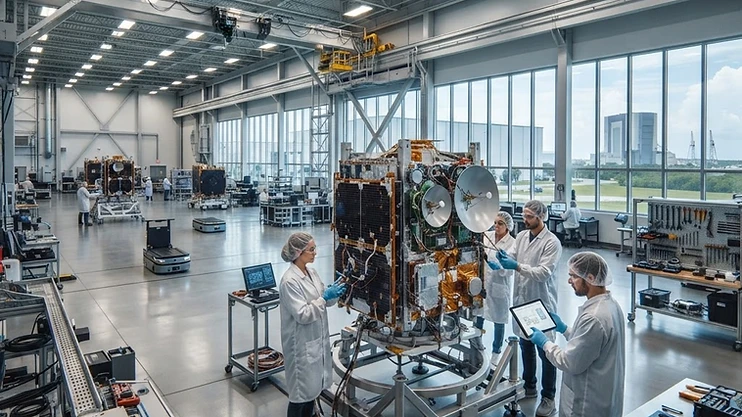
Our Melbourne team will develop, integrate and test new space and defense technologies, building on the capabilities we’ve brought to the market.
The aerospace landscape in Melbourne, Florida, is undergoing a profound transformation as the region pivots from a launch-centric hub to a comprehensive manufacturing and engineering powerhouse. On October 15, 2026, the Economic Development Commission of Florida’s Space Coast announced that CesiumAstro Inc., a leader in space and defense systems, will invest $25 million to establish a new facility in Melbourne. This move is not merely a corporate relocation; it represents a critical integration of advanced satellite communication technology into the local industrial fabric, creating 100 high-paying engineering and manufacturing jobs that will anchor the region’s defense capabilities for the next decade.
This development arrives at a moment when the global space economy has surged to $686 billion, according to the Space Foundation. For Melbourne, the arrival of CesiumAstro validates the city’s long-term strategy of cultivating a specialized workforce capable of handling the complexities of modern satellite integration. As global defense contractors look to shorten supply chains and increase the resilience of their hardware, the proximity of Melbourne’s talent pool—bolstered by institutions like Eastern Florida State College—has become the primary driver for this influx of capital and technical expertise.
Why this matters right now is clear: the Space Coast is no longer just a place where rockets leave the ground; it is becoming the place where the intelligence inside those rockets is designed and built. By embedding high-end manufacturing directly into the Melbourne corridor, companies like CesiumAstro are reducing the latency between design and deployment. This shift is essential for maintaining a competitive edge in an era where satellite constellations are being deployed at an unprecedented rate, requiring rapid iteration and robust, reliable hardware that can withstand the harsh realities of orbital operations.
What happened
CesiumAstro, headquartered in Austin, Texas, officially committed to a $25 million expansion in Melbourne, Florida, in mid-October 2026. The company, which specializes in active electronically steered antenna (AESA) systems and software-defined radio, plans to utilize the new facility to develop, integrate, and test next-generation space and defense technologies. According to Brett Paulson, Chief Operating Officer of CesiumAstro, the decision was driven by the need for direct access to the Space Coast’s specialized aerospace talent and existing infrastructure. The facility will serve as a dedicated hub for engineering and manufacturing, allowing the company to work in closer proximity to the customers and missions it supports, including various Department of Defense initiatives.
This investment follows a broader trend of industrial expansion in Brevard County. The Economic Development Commission of Florida’s Space Coast has been instrumental in facilitating these deals, positioning Melbourne as a premier destination for aerospace firms that require a blend of high-tech manufacturing and proximity to launch sites. The 100 jobs created will span a range of disciplines, from systems engineering to precision assembly, further diversifying the local economy. This expansion complements other recent regional developments, such as the opening of Eastern Florida State College’s Aerospace Center of Excellence in Titusville, which is specifically designed to feed the growing demand for skilled technicians in the aerospace sector.
Why it matters
The arrival of CesiumAstro signifies a structural shift in the Space Coast economy. Historically, the region relied heavily on the launch operations of NASA and private contractors. However, the current trend is toward vertical integration. By bringing the manufacturing of critical satellite components to Melbourne, the region is insulating itself from the volatility of launch schedules. If a launch is delayed, the manufacturing and engineering work continues, providing a more stable economic foundation for the city.
Furthermore, this creates a "cluster effect." As more specialized firms like CesiumAstro establish roots in Melbourne, they attract a secondary tier of suppliers and service providers. This ecosystem creates a self-reinforcing cycle of innovation. In two to three years, we expect to see a significant increase in the number of patents filed by local firms and a higher density of specialized engineering talent. This will likely lead to the emergence of local startups that spin out of these larger defense contractors, further diversifying the tech landscape in Viera and Melbourne. The long-term consequence is a more resilient, diversified economy that is less dependent on federal budget cycles and more driven by commercial and defense-industrial demand.
The breakdown
- Supply chain localization: By moving manufacturing to Melbourne, CesiumAstro is effectively shortening its supply chain, which is critical for defense-related hardware that requires strict quality control and rapid turnaround times. This reduces the risks associated with long-distance logistics and allows for tighter collaboration between the engineering teams and the end-users at nearby launch facilities.
- Workforce development synergy: The expansion aligns perfectly with the educational initiatives at Eastern Florida State College, which recently opened its Aerospace Center of Excellence. This creates a direct pipeline from the classroom to the factory floor, ensuring that the 100 new jobs can be filled by local talent rather than relying solely on out-of-state recruitment.
- Defense-industrial resilience: The focus on AESA systems and software-defined radio is a direct response to the increasing need for secure, resilient satellite communications. As the Department of Defense prioritizes space-based assets, having a manufacturing hub in Melbourne ensures that these critical technologies are produced in a secure, domestic environment.
- Economic diversification: The $25 million investment helps move the Space Coast beyond its reputation as a "launch-only" zone. By adding high-value manufacturing, the region is building a more robust industrial base that can weather fluctuations in the commercial space market.
- Infrastructure utilization: The choice of Melbourne leverages existing industrial parks and proximity to the Melbourne Orlando International Airport, which has become a focal point for aerospace logistics. This infrastructure is essential for the rapid transport of sensitive components and personnel.
- Competitive advantage for the region: Melbourne is successfully competing with other aerospace hubs by offering a combination of lower operational costs and a highly specialized, mission-focused workforce. This makes it an attractive alternative to more expensive tech hubs in California or the Northeast.
- Future-proofing the economy: By focusing on software-defined technologies, the region is positioning itself at the intersection of hardware and AI. This ensures that the local workforce remains relevant as the industry shifts toward more autonomous and intelligent satellite systems.
Key takeaways
- CesiumAstro’s $25 million investment marks a major win for Melbourne’s industrial diversification.
- The expansion creates 100 high-paying jobs, strengthening the local aerospace talent pipeline.
- Proximity to launch sites and existing infrastructure makes Melbourne a strategic choice for defense contractors.
- The move signals a broader trend of vertical integration in the Space Coast aerospace sector.
Our view
Most analysts view this as a simple "jobs announcement," but that misses the forest for the trees. This is a strategic consolidation of the defense-industrial base. We believe that Melbourne is rapidly becoming the "Silicon Valley of Space Hardware." While other regions focus on software, the Space Coast is winning the battle for physical, high-stakes manufacturing. The real winner here is the local workforce, which is seeing a transition from low-skill assembly to high-skill systems engineering. We expect that within five years, Melbourne will be the primary hub for satellite component manufacturing in the United States, effectively displacing older, less efficient manufacturing centers. The risk, of course, is over-reliance on defense spending, but given the current geopolitical climate, this is a risk that the region is well-positioned to manage.
What to do about it
- For local businesses: Look for opportunities to provide ancillary services to these new aerospace hubs, such as specialized logistics, precision machining, or cybersecurity consulting.
- For educational institutions: Continue to align curricula with the specific technical requirements of firms like CesiumAstro, focusing on software-defined radio and AESA technology.
- For municipal leaders: Prioritize infrastructure investments that support high-tech manufacturing, such as reliable power grids and high-speed data connectivity, to ensure the region remains attractive to future investors.
- For job seekers: Invest in certifications related to aerospace manufacturing and systems integration to take advantage of the high-paying roles being created in the region.
The bottom line
CesiumAstro’s expansion into Melbourne is a clear indicator that the Space Coast is maturing into a sophisticated, multi-faceted aerospace hub. By anchoring high-end manufacturing in the region, the company is not just creating jobs; it is helping to build a resilient, future-proof economy. As the space industry continues to grow, Melbourne’s role as a center for both innovation and production will only become more vital. This is a transformative moment for the city and the broader Space Coast.