


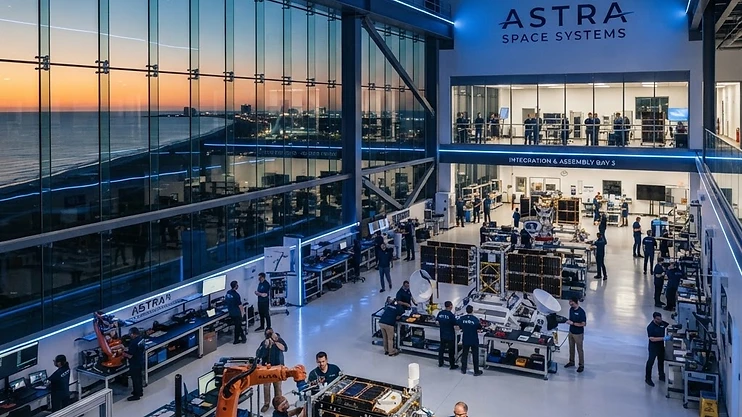
The landscape of Melbourne, Florida, is undergoing a profound structural shift that extends far beyond the traditional boundaries of aerospace manufacturing.
The New Frontier in Melbourne
The landscape of Melbourne, Florida, is undergoing a profound structural shift that extends far beyond the traditional boundaries of aerospace manufacturing. As of October 2026, the region is no longer merely a launch site for government-contracted missions; it has evolved into a high-density ecosystem where autonomous systems, satellite production, and AI-driven logistics converge. This transformation is not happening in a vacuum but is being driven by a deliberate influx of international capital and a strategic alignment between local educational institutions and private industry.
Recent developments, such as the inauguration of Argotec’s U.S. production facility in Melbourne and the massive expansion plans announced by Relativity Space, signal that the Space Coast is capturing a disproportionate share of the global aerospace value chain. This is not just about building rockets; it is about building the digital and physical infrastructure that will support the next decade of orbital operations. The convergence of these entities creates a 'gravity well' effect, pulling in talent, capital, and supply chain partners that are fundamentally altering the economic profile of Brevard County.
For business leaders and technologists in Viera, Palm Bay, and Melbourne, this shift represents both a massive opportunity and a significant operational challenge. The integration of AI into the manufacturing floor and the push for autonomous in-space refueling depots—led by local innovators like Spargo Space—are setting new benchmarks for efficiency. Understanding how these global shifts land on the Space Coast is essential for any organization looking to remain competitive in an increasingly automated and space-centric economy.
What happened
The acceleration of the Space Coast’s industrial base has been marked by a series of high-profile investments throughout 2026. In April, Argotec, an Italian aerospace leader, officially opened its first U.S.-based satellite production facility in Melbourne, a move projected to bring $25 million in capital investment and triple its local workforce within two years. This facility is specifically designed to support rapid, scalable satellite delivery, a critical requirement for the modern commercial and government mission profile. Shortly thereafter, in July 2026, Relativity Space announced a massive expansion in Brevard County, promising to create thousands of high-paying jobs by 2034. This expansion is supported by a broader regional strategy, exemplified by Space Florida’s recent partnership with the United Kingdom’s Department for Science, Innovation and Technology to fund joint aerospace research and commercialization projects.
These developments are occurring alongside a surge in specialized, deep-tech startups. Companies like Spargo Space, founded in 2025 and based in Melbourne, are focusing on the next frontier: autonomous in-space refueling depots. This is a departure from the traditional 'launch and forget' model, moving toward a sustainable, persistent orbital infrastructure. Simultaneously, the workforce pipeline is being reinforced by initiatives like the $1.5 million NASA-backed workforce hub announced in August 2026, which aims to bridge the gap between traditional manufacturing and the new requirements of cybersecurity, logistics, and AI-integrated production. The local ecosystem is effectively creating a closed-loop system where research, manufacturing, and operational deployment happen within a few miles of the Kennedy Space Center.
Why it matters
The structural change occurring in Melbourne is the transition from a service-based aerospace economy to a product-and-infrastructure-based one. Historically, the Space Coast relied heavily on government contracts and launch services. Today, the presence of companies like Argotec and the growth of autonomous systems providers mean that the region is becoming a hub for intellectual property and high-value manufacturing. This shift creates a 'moat' around the local economy; as more specialized manufacturing facilities open, the supply chain becomes more localized, reducing dependency on external logistics and increasing the speed of innovation.
For local businesses, the second-order consequence is a tightening of the labor market for high-skill technical roles. As AI adoption becomes standard in these facilities, the demand for workers who can manage, maintain, and optimize autonomous systems will outpace the supply of traditional manufacturing labor. This is why the focus on apprenticeship programs, such as those coordinated by Eastern Florida State College, is so vital. In two to three years, the organizations that will thrive are those that have successfully integrated AI into their operational workflows, not just as a tool for efficiency, but as a core component of their product delivery. The risk for laggards is clear: they will be priced out of the local talent market and unable to compete with the rapid iteration cycles of the new, AI-native aerospace firms.
The breakdown
-
Localized Supply Chain Resilience: The influx of international firms like Argotec means that critical components are now being manufactured in Melbourne rather than imported. This reduces lead times for satellite deployment and creates a robust local network of suppliers who are becoming experts in space-grade hardware. By keeping the production cycle local, these companies are insulating themselves from global supply chain shocks.
-
AI-Integrated Manufacturing: The new facilities in Melbourne are not just assembly lines; they are data-driven environments where AI monitors production quality in real-time. This reduces waste and allows for the rapid prototyping of satellite components, which is essential for the competitive commercial space market. Companies that fail to adopt these digital twin and predictive maintenance technologies will find themselves unable to meet the quality standards required by modern government and commercial contracts.
-
The Rise of Autonomous Infrastructure: Startups like Spargo Space are shifting the focus from launch vehicles to in-space utility, such as refueling and maintenance. This represents a fundamental change in the economics of space, where the cost of a mission is no longer tied solely to the initial launch. By enabling longer-duration missions, these companies are creating a new market for orbital services that will be managed from the ground in Melbourne.
-
Workforce Evolution and Apprenticeships: The Space Coast Consortium Apprenticeship Program is becoming the gold standard for workforce development. By combining classroom learning at institutions like Eastern Florida State College with hands-on experience at firms like L3Harris or the new Argotec facility, the region is creating a pipeline of talent that is ready for the realities of modern aerospace. This model is essential for preventing the 'AI displacement' of younger workers, ensuring they are trained to work alongside, rather than be replaced by, automated systems.
-
International Strategic Partnerships: The agreement between Space Florida and the UK’s Department for Science, Innovation and Technology is a blueprint for future growth. By connecting local firms with international capital and research, the region is ensuring that it remains a global, rather than just a national, player. This internationalization of the Space Coast economy provides a hedge against domestic political shifts in space policy.
-
The 'Gravity Well' Effect: As more companies establish operations near the Kennedy Space Center, the cost of doing business decreases due to the proximity of specialized infrastructure and talent. This creates a self-reinforcing cycle where the success of one company attracts another, further cementing Melbourne’s status as a global aerospace hub. This density is what makes the region attractive to venture capital and private equity firms looking for high-growth opportunities.
-
Policy-Driven Growth: State and local policy, led by organizations like the Economic Development Commission of Florida’s Space Coast, is actively curating the business environment to favor high-tech, deep-tech, and aerospace firms. This proactive approach to economic development ensures that the infrastructure—from power grids to high-speed data networks—is ready to support the next generation of industrial growth. This level of coordination is a significant competitive advantage over other regions that rely on passive economic growth.
Key takeaways
- Melbourne is transitioning from a launch-focused economy to a high-value, autonomous aerospace manufacturing hub.
- AI integration is no longer optional; it is the baseline for competitiveness in the new Space Coast industrial ecosystem.
- Local workforce development programs are the primary defense against the potential displacement of young workers by AI.
- International partnerships are providing a critical buffer and growth engine for local aerospace firms.
- The 'gravity well' of the Space Coast is creating a self-sustaining cycle of investment and innovation that will define the region for the next decade.
Our view
At Hermida Technologies, we believe the most significant trend in the Space Coast is the move toward 'autonomous utility.' Most coverage of the region focuses on the spectacle of rocket launches, but the real value is being created in the quiet, high-tech manufacturing facilities in Melbourne and Viera. The companies that will dominate the next decade are not the ones launching the most rockets, but the ones building the infrastructure that makes those rockets useful—refueling, satellite maintenance, and data processing.
We believe that the 'AI displacement' narrative is largely overblown for the Space Coast. The reality is that the region is facing a massive labor shortage for high-skill roles. The challenge is not that AI will take jobs, but that the industry will fail to train enough people to manage the AI-driven systems that are coming online. The winners will be the companies that invest heavily in internal training and apprenticeship programs, effectively turning their workforce into a competitive advantage. Those who wait for the 'perfect' candidate to emerge from traditional university pipelines will lose to those who build their own talent from the ground up. The Space Coast is becoming a high-tech laboratory, and the organizations that treat it as such will thrive, while those clinging to the old, service-heavy model will find themselves obsolete.
What to do about it
-
Invest in AI-Native Workflows: Business leaders should audit their current manufacturing and operational processes to identify where AI can replace manual, repetitive tasks, allowing their human workforce to focus on high-level system management and oversight.
-
Partner with Local Educational Institutions: Organizations should actively engage with Eastern Florida State College and the Space Coast Consortium Apprenticeship Program to influence curriculum and secure a pipeline of talent that is trained on the specific technologies they use.
-
Prioritize Local Supply Chain Integration: Instead of relying on global, fragile supply chains, companies should look to partner with the growing network of local manufacturers in Melbourne and Palm Bay to reduce lead times and increase operational resilience.
-
Adopt a 'Space-First' Digital Strategy: For firms in the aerospace sector, this means moving data processing and operational control closer to the edge, utilizing the local infrastructure to support low-latency communication with orbital assets.
The bottom line
Melbourne, Florida, is no longer just a gateway to the stars; it is the engine room of the new space economy. By successfully integrating international investment, advanced AI-driven manufacturing, and a robust local workforce pipeline, the region has secured its position as a global leader in aerospace innovation. For businesses operating in this space, the path forward is clear: embrace the shift toward autonomous systems and invest deeply in the local talent that will operate them. The Space Coast is not just growing; it is evolving into a new, more resilient, and highly sophisticated industrial powerhouse.