


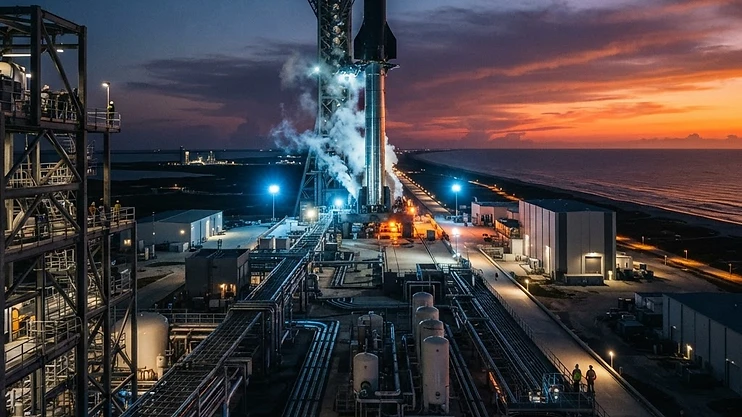
The era of 'launching when ready' is over; we are entering an era of 'launching on schedule,' and that requires an infrastructure that is as sophisticated as the vehicles it supports.
The rapid acceleration of commercial space activity on Florida’s Space Coast has transformed the region into the undisputed epicenter of the global aerospace industry. With launch counts at Kennedy Space Center (KSC) surging from 31 in 2020 to over 100 annually by 2025, the physical and digital infrastructure supporting this growth is reaching a breaking point. This is no longer just a story of rocket science; it is a story of industrial capacity, civil engineering, and the urgent need for a modernized backbone to support a multi-billion dollar commercial ecosystem that is currently outgrowing its Apollo-era foundations.
For businesses in Melbourne, Viera, and the surrounding areas, this bottleneck represents both a significant risk and a massive opportunity. As NASA and private giants like Blue Origin and SpaceX push the limits of what is possible, the local supply chain, power grid, and transportation networks are being tested in real-time. The transition from a government-led space program to a high-frequency commercial launch environment requires a fundamental shift in how we view regional infrastructure—moving from maintenance-based models to high-throughput, scalable systems that can handle the demands of a 24/7 space economy.
This is the defining challenge for the Space Coast in 2026. As federal agencies and private contractors scramble to secure funding and permitting for massive expansion projects, the local business community must understand that the future of the region’s economy depends on solving these structural constraints. The era of 'launching when ready' is over; we are entering an era of 'launching on schedule,' and that requires an infrastructure that is as sophisticated as the vehicles it supports.
What happened
The current crisis is rooted in a simple mathematical reality: the infrastructure at Kennedy Space Center and the surrounding Space Coast region was never designed for the current volume of commercial activity. A June 2026 report from the NASA Office of Inspector General highlighted that much of the facility’s core infrastructure dates back to the Apollo era, with deteriorating power systems and crumbling road networks that are increasingly unable to support the heavy logistics required for modern launch operations. The report estimated that a minimum of $1 billion is required to modernize these systems to meet the demands of the Artemis program and the concurrent surge in commercial launches.
In response, the federal government has begun to mobilize. Congress recently approved $250 million in initial funding to stabilize critical systems, but this is widely viewed as a stopgap measure. Simultaneously, state-level initiatives are gaining momentum. The Titusville-Cocoa Airport Authority recently secured a $15 million grant from the Florida Department of Transportation’s Spaceport Improvement Program to upgrade infrastructure at the Space Coast Regional Airport, aiming to attract more aerospace manufacturing and logistics firms to the area. Furthermore, Space Florida has initiated permitting for a massive 217-acre commercial aerospace facility near the Launch and Landing Facility at KSC, signaling a clear intent to expand the footprint of private industry within the federal site.
Private sector investment is also moving at a breakneck pace. Blue Origin, for instance, has committed to a $600 million expansion of its Merritt Island campus, a move expected to create 500 high-skilled aerospace jobs. Meanwhile, SpaceX continues to 'drive hard' on the construction of Starship-related infrastructure at Pad 39A, with expectations for a Florida-based Starship launch by the end of 2026. These projects are not occurring in a vacuum; they are part of a broader, often opaque, landscape of 'Project Horseshoe' and other mystery-tenant developments that are currently seeking hundreds of millions in financing to establish a permanent presence in the region.
Why it matters
The deeper implication of this infrastructure crunch is the potential for a 'growth ceiling' that could stifle the region’s economic momentum. If the power, water, and transportation systems cannot keep pace with the launch cadence, the Space Coast risks losing its competitive edge to other emerging spaceports. The second-order consequence is a shift in the power dynamic between public and private entities. As NASA struggles to fund its own modernization, it is increasingly turning to public-private partnerships, as evidenced by the proposed 'Space Ready 2.0 Act,' which would allow the agency to accept voluntary private contributions for infrastructure projects. This marks a structural change in how federal land is managed and developed.
For local businesses in Melbourne and Viera, this means the supply chain is about to get much more complex. The demand for specialized labor, high-bandwidth connectivity, and advanced manufacturing facilities will outstrip current supply. Companies that can pivot to support this infrastructure—whether through specialized construction, cybersecurity for launch systems, or AI-driven logistics—will find themselves in a prime position to capture value. Conversely, businesses that rely on legacy infrastructure or fail to adapt to the high-frequency requirements of the new space economy will find themselves increasingly marginalized.
In 2-3 years, we expect to see a more integrated, 'smart' spaceport environment. The successful integration of AI-driven scheduling and simulation tools, such as those being developed by emerging aerospace tech firms, will be essential to managing the congestion at the launch pads. The region will likely see a consolidation of smaller contractors as the barrier to entry rises, driven by the need for massive capital investment in infrastructure. The winners will be those who can navigate the intersection of federal policy, state-level economic development, and private capital, effectively becoming the 'utility providers' for the next generation of space exploration.
The breakdown
- The $1 Billion Infrastructure Gap: The NASA Office of Inspector General has identified a massive shortfall in funding required to modernize Apollo-era systems at KSC. This gap represents a critical risk to the Artemis program and the broader commercial launch schedule. Without significant federal and private investment, the facility will struggle to maintain the operational capacity required for the next decade of growth.
- Public-Private Partnership Evolution: The introduction of the Space Ready 2.0 Act signals a shift toward a model where private companies directly fund federal infrastructure. This creates a new class of 'infrastructure stakeholders' who will have more influence over how KSC is managed and prioritized. It effectively turns the space center into a hybrid public-private utility.
- The Space Coast Regional Airport Expansion: The $15 million grant for the Space Coast Regional Airport is a strategic move to decentralize aerospace manufacturing away from the immediate KSC footprint. By creating a secondary hub in Titusville, the region can better manage the logistics of rocket component manufacturing and assembly. This reduces the strain on KSC’s internal roads and facilities.
- The 'Project Horseshoe' Mystery: The emergence of large-scale, unnamed projects like 'Project Horseshoe' indicates that major aerospace players are still in a massive land-grab phase. These projects require significant environmental mitigation and infrastructure support, which will test the local permitting and regulatory bodies. The speed at which these projects move will be a key indicator of the region's administrative agility.
- AI-Driven Operational Efficiency: As launch frequency increases, manual scheduling and simulation are no longer viable. We are seeing a rise in AI-based enterprise software designed to optimize aerospace design and launch logistics. Companies that adopt these tools will be able to squeeze more capacity out of existing infrastructure, effectively delaying the need for massive new physical builds.
- The Blue Origin and SpaceX Dominance: The massive capital commitments from Blue Origin and SpaceX are setting the standard for what 'modern' infrastructure looks like. Their investments in Merritt Island and Pad 39A are not just for their own use; they are creating a gravitational pull that forces the entire local supply chain to upgrade its capabilities. Smaller firms must align with these standards to remain relevant.
- Environmental and Regulatory Hurdles: The expansion of aerospace facilities is increasingly bumping against environmental protections for local habitats, such as the Florida scrub-jay and gopher tortoise. Balancing the 'space boom' with environmental stewardship is becoming a major political and legal challenge. This will likely lead to more complex and costly permitting processes in the coming years.
Key takeaways
- The Space Coast is facing a $1 billion infrastructure deficit that threatens to bottleneck the current launch boom.
- Federal and state funding is flowing, but it is insufficient to meet the long-term demands of the commercial space industry.
- Public-private partnerships are becoming the primary vehicle for infrastructure development at Kennedy Space Center.
- Local businesses must prepare for a shift toward high-frequency, high-tech operational requirements to remain in the supply chain.
- Environmental and regulatory hurdles will continue to complicate and slow down large-scale infrastructure projects.
Our view
Most coverage of the Space Coast’s growth focuses on the 'glamour' of the launches—the fire, the noise, and the mission success. This misses the real story: the boring, expensive, and absolutely critical work of building the industrial plumbing that makes those launches possible. We believe the current narrative that 'more funding will solve it' is fundamentally flawed. The problem isn't just a lack of money; it’s a lack of a unified, long-term infrastructure strategy that bridges the gap between federal NASA requirements and the needs of private commercial entities.
We expect that the next two years will be defined by a 'consolidation of capacity.' The companies that can successfully integrate their operations with the existing, albeit aging, infrastructure while simultaneously investing in their own private, high-tech facilities will win. The losers will be the legacy contractors who wait for the government to fix the roads and power grids for them. Most analysts are underestimating the role of AI and software in this transition. The physical infrastructure is only half the battle; the other half is the digital orchestration of thousands of moving parts. The firms that treat their launch operations as a software-defined problem will be the ones that dominate the Space Coast in 2030.
Furthermore, the 'Space Ready 2.0 Act' is a harbinger of a much larger trend: the privatization of space infrastructure. We believe that within five years, the distinction between 'NASA property' and 'commercial spaceport' will be almost entirely blurred. This is a positive development for efficiency, but it will create significant friction with local communities and environmental groups. The most successful companies will be those that proactively manage these stakeholder relationships, rather than viewing them as obstacles to be cleared. The Space Coast is no longer a government outpost; it is a commercial industrial zone, and it needs to be managed with the same rigor as a major international logistics hub.
What to do about it
- Audit your infrastructure dependency: Business leaders should assess how much of their operational capacity relies on aging public infrastructure at KSC or surrounding areas. Identify single points of failure and develop contingency plans for power, connectivity, and logistics.
- Invest in AI-driven logistics: If your company is involved in the aerospace supply chain, prioritize the adoption of AI-based scheduling and simulation software. This will allow you to optimize your own throughput and better integrate with the high-frequency launch schedules of your partners.
- Engage in public-private partnerships: For larger firms, explore opportunities to participate in the new wave of infrastructure funding. Being a 'first mover' in these partnerships can provide significant leverage and influence over the development of the regional spaceport ecosystem.
- Diversify your supply chain: Given the potential for permitting delays and infrastructure bottlenecks, ensure your supply chain is not overly reliant on a single location or facility. Look for opportunities to partner with firms in the Titusville or Melbourne areas that are benefiting from the recent infrastructure grants.
- Proactively manage environmental compliance: Do not wait for regulatory hurdles to stall your projects. Invest in early environmental impact assessments and build strong relationships with local environmental groups to ensure your expansion plans are sustainable and socially responsible.
The bottom line
The Space Coast is at a critical inflection point where the ambition of the commercial space industry is finally outstripping the physical reality of its infrastructure. While the $1 billion repair bill for Kennedy Space Center is daunting, it is also the price of admission for a region that has successfully reinvented itself as the world's premier spaceport. The winners of this next phase will not be those who simply build more, but those who build smarter, integrating advanced software and private capital to overcome the limitations of the past. For Melbourne and Viera, the next few years will be a test of whether the region can evolve from a launch site into a fully realized, high-tech industrial powerhouse.