


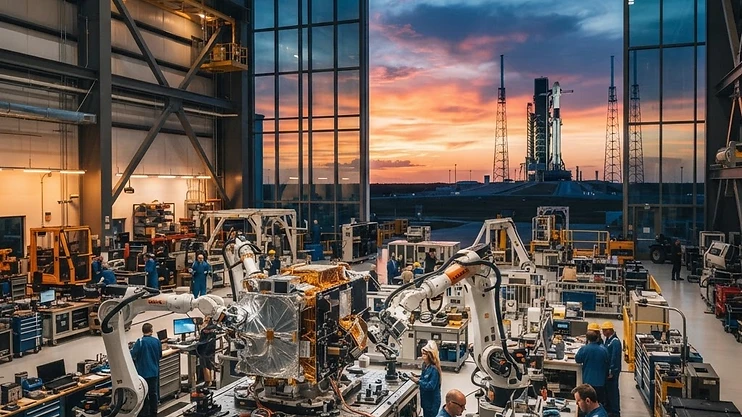
Argotec is a strong indicator of the gravitational pull to the Space Coast.
The gravitational pull of Florida’s Space Coast has shifted from a temporary phenomenon to a permanent economic reality. As of October 2026, the region surrounding Melbourne, Viera, and the Kennedy Space Center is no longer just a place where rockets go to leave the planet; it is becoming the place where the next generation of aerospace infrastructure is being engineered, manufactured, and scaled. With billions in private investment from firms like Stoke Space and Relativity Space, and the strategic arrival of international players like Argotec, the Space Coast is experiencing a structural transformation that mirrors the industrial booms of the 20th century, but with a 21st-century focus on autonomy, reusability, and rapid-cycle production.
This shift is not merely about more launches; it is about the integration of the entire supply chain into the local fabric of Brevard County. From the expansion of the Space Coast Innovation Park in Titusville to the specialized satellite manufacturing hubs in Melbourne, the region is solving the 'last mile' problem of space logistics. As NASA grapples with aging infrastructure and the potential relocation of its headquarters to the very soil where its rockets launch, the private sector is moving faster than federal policy, creating a high-stakes environment where local infrastructure—roads, power grids, and talent pipelines—is now the primary bottleneck for global space dominance.
What happened
The landscape of the Space Coast has undergone a radical acceleration in the last six months. In April 2026, Italian aerospace firm Argotec inaugurated its first U.S.-based satellite production facility in Melbourne, signaling that the region is now a global destination for international aerospace capital. This was followed by a massive $1 billion funding round for Stoke Space, which is aggressively expanding its launch and recovery infrastructure in Cape Canaveral ahead of its 2027 orbital flight goals. Meanwhile, Relativity Space has committed to a massive expansion that will bring 590 high-paying jobs to the region, supported by over half a billion dollars in infrastructure investment.
Simultaneously, the political and regulatory environment is catching up. Senator Ashley Moody’s 'Space Ready 2.0 Act' has gained traction, proposing a pilot program that allows NASA to accept private contributions for infrastructure repairs at the Kennedy Space Center—a critical move given that the NASA Office of Inspector General recently highlighted $1 billion in necessary repairs for aging Apollo-era systems. As KSC Director Brian Hughes noted in June 2026, the challenge is no longer just about rocket science; it is about the 'good-old-fashioned blacktop' and electrical power delivery required to support a high-cadence launch environment.
Why it matters
The deeper consequence of this boom is the decoupling of space operations from traditional federal procurement cycles. When companies like Stoke Space or Relativity Space invest half a billion dollars into local infrastructure, they are creating a 'moat' that makes the Space Coast the only viable location for their operations. This creates a feedback loop: as more private infrastructure is built, the cost of launching decreases, which attracts more startups like the Melbourne-based Spargo Space, which is currently developing autonomous in-space refueling depots.
For the local economy in Viera and Melbourne, this means a transition from a tourism-and-launch-viewing economy to a high-tech manufacturing hub. However, this growth is not without friction. The 'Space Coast building boom' is putting immense pressure on local infrastructure, with 33% of local voters citing traffic and utility strain as their primary concern. The success of this region now depends on whether local government can scale municipal services as fast as private companies can scale rocket production. If the infrastructure fails, the 'gravitational pull' of the Space Coast could turn into a repelling force for the very talent these companies need to hire.
The breakdown
- Private-Public Infrastructure Integration: The Space Ready 2.0 Act represents a fundamental shift in how federal facilities are maintained, allowing private capital to bypass bureaucratic gridlock to fix critical launch infrastructure.
- The Satellite Manufacturing Pivot: The arrival of Argotec in Melbourne proves that the region is no longer just a launch pad; it is a full-stack manufacturing hub where satellites are designed, built, and integrated locally.
- Capital Concentration: With over $3.3 billion in private funding attracted to the region, the Space Coast has become the most efficient capital-allocation environment for aerospace in the United States.
- The Infrastructure Bottleneck: Aging power grids and road networks at Kennedy Space Center are now the primary risks to the 2027 launch cadence, forcing companies to invest in their own utility solutions.
- Job Market Transformation: The influx of 590+ high-salary roles from Relativity Space is driving a shift in the local labor market, demanding a higher concentration of specialized engineering talent in Brevard County.
- Autonomous Logistics: Startups like Spargo Space are moving beyond launch vehicles to focus on in-space infrastructure, such as refueling depots, which will be the next major frontier for the local space economy.
Key takeaways
- The Space Coast is transitioning from a launch-only site to a comprehensive aerospace manufacturing and R&D ecosystem.
- Aging federal infrastructure at Kennedy Space Center is being addressed through innovative private-public partnership legislation.
- Local infrastructure, specifically traffic and power, is the biggest risk to the continued growth of the aerospace sector in Melbourne and Viera.
- International firms are increasingly viewing the Space Coast as their primary U.S. strategic base, not just a secondary location.
- The next phase of growth will be driven by in-space services, such as refueling and orbital maintenance, rather than just rocket launches.
Our view
Most analysts focus on the 'rocket race'—who launches first or who has the biggest payload. This is a mistake. The real story is the 'infrastructure race.' The companies that win in the next decade will be those that control the ground-based logistics, the power supply, and the local manufacturing supply chain. We believe that the Space Coast will eventually force NASA to move its headquarters to Florida, not because of political pressure, but because the center of gravity for the entire industry has already moved there. The companies that are currently investing in local infrastructure in Melbourne and Titusville are building the 'railroads' of the 21st century. Those who fail to secure their footprint in this region now will find themselves locked out of the most efficient launch and manufacturing ecosystem on the planet.
What to do about it
- For local business leaders: Invest in service-sector support for the aerospace industry, specifically in high-end logistics, specialized manufacturing components, and workforce housing.
- For technical leaders: Focus on 'dual-use' technologies that can serve both commercial satellite constellations and defense-related space infrastructure.
- For policy makers: Prioritize the expansion of the power grid and road infrastructure in the Melbourne-Viera corridor to prevent the 'infrastructure bottleneck' from stalling private investment.
- For investors: Look beyond the launch vehicle manufacturers and focus on the 'picks and shovels' of the space economy—the companies building the refueling, power, and data-transport infrastructure.
The bottom line
The Space Coast is no longer a peripheral launch site; it is the industrial heart of the new space economy. As private capital continues to outpace federal infrastructure investment, the region’s ability to manage this growth will determine its long-term dominance. Melbourne and Viera are at the center of this transformation, and the next five years will define the region's role in the global aerospace hierarchy for the next half-century.