


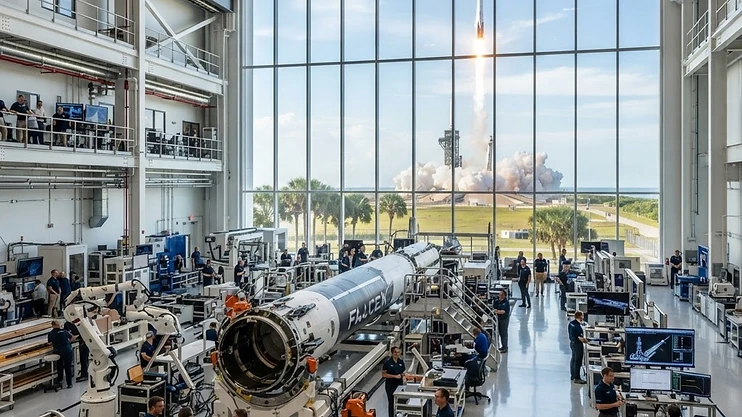
Argotec is a strong indicator of the gravitational pull to the Space Coast.
The landscape of Florida’s Space Coast is undergoing a structural transformation that transcends the traditional rhythm of rocket launches. While the roar of engines at Kennedy Space Center remains the region's heartbeat, a new, quieter, and more permanent industrial revolution is taking hold in the business parks of Melbourne and Viera. This shift is defined by the arrival of international and domestic aerospace giants who are no longer just visiting for a launch window, but are establishing permanent, high-tech manufacturing hubs that promise to reshape the local economy for decades to come.
This transition is not merely about job creation; it is about the creation of a self-sustaining aerospace ecosystem. With the recent expansion announcements from companies like Relativity Space and the establishment of Argotec’s U.S. production facility, Melbourne is positioning itself as the primary nexus for satellite and launch vehicle manufacturing in the United States. This convergence of capital, talent, and infrastructure is creating a gravitational pull that is increasingly difficult for global aerospace firms to ignore, effectively turning the Space Coast into the Silicon Valley of the stars.
For local leaders and business owners in Melbourne, Viera, and the surrounding areas, this represents a fundamental change in the regional value proposition. We are moving away from a service-based economy that supports launch operations toward a high-value manufacturing economy that designs, builds, and integrates the next generation of space infrastructure. Understanding this shift is critical for any organization looking to thrive in the region, as the ripple effects of this industrial expansion will touch everything from local real estate and utility demands to the specialized labor market and educational partnerships.
What happened
The recent surge in industrial activity on the Space Coast has been marked by two significant milestones that underscore the region's growing importance. In April 2026, Argotec, an Italian aerospace firm, officially inaugurated its first U.S.-based satellite production facility in Melbourne. This facility is designed to support rapid, scalable satellite delivery for both U.S. government and commercial missions, signaling a move toward high-volume, agile manufacturing that was previously rare in the region. Lynda Weatherman, President and CEO of the Economic Development Commission of Florida’s Space Coast, noted that Argotec’s arrival is a "strong indicator of the gravitational pull to the Space Coast," emphasizing that for companies looking to compete globally, locating in Melbourne has become a strategic imperative.
Following this, in July 2026, Relativity Space announced a massive expansion plan for the Florida coast, projected to create thousands of high-paying jobs by 2034. This expansion is not just a small satellite office; it represents a long-term commitment to the region’s manufacturing capacity. Space analyst Dr. Ken Kremer of Space UpClose highlighted the necessity of this growth, stating, "We need more companies to invest here because the space launch market is growing phenomenally." These developments are occurring against a backdrop of international cooperation, such as the recent agreement between Space Florida and the United Kingdom’s Department for Science, Innovation and Technology to fund joint aerospace research and commercialization projects. These moves collectively signal that Melbourne is no longer just a launch pad; it is becoming a global center for aerospace innovation.
Why it matters
The structural change occurring in Melbourne is the transition from a "launch-only" economy to a "design-build-launch" economy. Historically, the Space Coast benefited from the transient nature of launch operations—companies would arrive, launch, and leave. The current trend of permanent manufacturing facilities changes the economic multiplier effect significantly. When a company like Argotec or Relativity Space builds a factory, they are investing in local supply chains, local engineering talent, and local infrastructure. This creates a more resilient economic base that is less susceptible to the volatility of individual launch schedules.
In the next two to three years, we expect to see a "clustering effect" where secondary and tertiary suppliers—specialized machine shops, software firms, and logistics providers—flock to the Viera and Melbourne areas to be closer to these anchor tenants. This will drive up demand for specialized industrial real estate and put pressure on the local workforce to upskill rapidly. Organizations that fail to integrate into this new supply chain will find themselves increasingly isolated from the primary economic engine of the region. Conversely, those that align their services with the needs of these large-scale manufacturers will find a captive, high-growth market right in their backyard. The long-term consequence is a more diversified and robust regional economy that can sustain itself even if the global launch market experiences cyclical downturns.
The breakdown
- Supply chain localization: As major manufacturers establish permanent footprints, they are actively seeking local partners to reduce logistics costs and improve lead times. This creates a massive opportunity for local fabrication and precision engineering firms to pivot toward aerospace-grade standards.
- Workforce development pressure: The influx of thousands of high-paying jobs requires a massive pipeline of skilled labor, from CNC operators to aerospace engineers. Local institutions like Florida Tech and Eastern Florida State College will need to accelerate their curriculum alignment to meet this demand.
- Infrastructure and utility demands: Large-scale manufacturing facilities require significant power, water, and high-speed data connectivity. The city of Melbourne and Viera developers must prioritize industrial-grade infrastructure upgrades to keep pace with these corporate requirements.
- International investment flows: The partnership between Space Florida and the UK government is a blueprint for future international collaboration. We expect to see more foreign aerospace firms using Melbourne as their primary entry point into the U.S. market.
- Real estate market shifts: The demand for industrial space is already tightening, and the need for housing for a high-income workforce will continue to drive development in Viera and surrounding suburbs. This will likely lead to a shift in the local commercial real estate landscape toward mixed-use industrial and office parks.
- Regulatory and policy alignment: Local government bodies must remain agile in their permitting and zoning processes to accommodate the rapid growth of these companies. The ability to fast-track facility construction will be a key competitive advantage for the region.
- Technological spillover: The presence of advanced manufacturing facilities will inevitably lead to technology transfer and innovation in other sectors, such as cybersecurity and AI, as these companies bring their proprietary software and operational methodologies to the region.
Key takeaways
- Melbourne is transitioning from a launch site to a global aerospace manufacturing hub.
- Permanent facilities from companies like Argotec and Relativity Space are creating a more resilient, high-value local economy.
- Local businesses must pivot to support the specialized supply chain needs of these aerospace giants to capture new growth.
- The region faces a critical need for workforce upskilling and industrial infrastructure investment to sustain this momentum.
Our view
Most coverage of the Space Coast focuses on the spectacle of the launch, but the real story is the quiet, industrial build-out happening in the business parks of Melbourne and Viera. We believe that the "launch-only" era is effectively over. The future of the region belongs to the companies that can master the integration of software, AI, and advanced manufacturing. We expect to see a consolidation of the local aerospace supply chain, where smaller, less efficient firms are either acquired or pushed out by more agile, tech-forward competitors.
What most analysts get wrong is the assumption that this growth is purely dependent on government contracts. In reality, the commercialization of space is driving a private-sector demand that is far more stable and predictable than the boom-and-bust cycles of government-funded programs. The winners in this new era will be the local firms that treat aerospace manufacturing as a high-tech software problem—optimizing for speed, precision, and data-driven iteration. If you are a local business leader, stop looking at the sky and start looking at the factory floor. The real money is being made in the assembly lines, not just on the launch pad.
What to do about it
- Audit your supply chain capabilities: If you are a local manufacturer, assess whether your current certifications and equipment meet the stringent requirements of aerospace contractors. Pursue AS9100 certification if you haven't already.
- Invest in specialized talent: Partner with local universities to create internship and apprenticeship programs that feed directly into the aerospace manufacturing pipeline. This is the only way to secure the talent you need in a tightening market.
- Upgrade your digital infrastructure: Ensure your facility has the high-speed, secure data connectivity required to handle the massive data loads associated with modern aerospace design and manufacturing.
- Engage with the EDC: The Economic Development Commission of Florida’s Space Coast is the primary gateway for these new companies. Ensure your business is visible and active in their networking and industry events.
The bottom line
The transformation of Melbourne into a global aerospace manufacturing powerhouse is not a future possibility; it is a current reality. As companies like Relativity Space and Argotec solidify their presence, the region is entering a new phase of economic maturity. For local leaders, the mandate is clear: adapt to the requirements of this high-tech ecosystem or risk being left behind. The Space Coast is no longer just a place to watch history happen; it is the place where the future of aerospace is being built, one satellite at a time.