


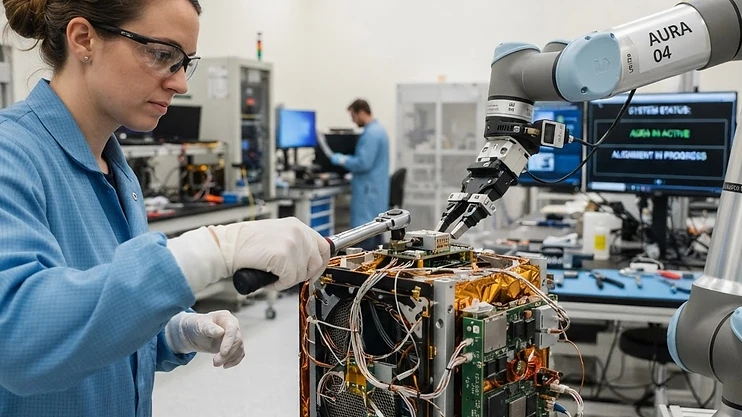
Space Coast employers should take that as a warning about how they design AI adoption, not as evidence that newer workers have no place.
The Space Coast is currently experiencing a dual-track workforce evolution. On one hand, massive investments from companies like Blue Origin and the development of the Space Coast Innovation Park are creating thousands of high-paying aerospace jobs. On the other hand, the rapid integration of AI into manufacturing, logistics, and cybersecurity is fundamentally changing the nature of those roles. This 'workforce paradox' is the defining challenge for the region’s leaders, who must balance the need for efficiency with the imperative to build a sustainable, long-term talent pipeline.
Recent data from Stanford and local workforce reports suggest that while AI is not causing widespread displacement, it is changing the 'bottom rungs' of the career ladder. For young workers entering the aerospace industry, this means that entry-level roles are becoming more automated, potentially reducing the number of traditional 'on-the-job' training opportunities. This is a critical issue for a region that relies on a steady stream of new talent to support its rapid growth.
This article explores how Space Coast employers are navigating this transition. From the Space Coast Consortium Apprenticeship Program to NASA-backed workforce hubs, the region is experimenting with new models of education and training. The goal is to ensure that the workforce of tomorrow is not just capable of using AI, but is also grounded in the fundamental engineering and manufacturing skills that are the bedrock of the aerospace industry.
What happened
On August 21, 2026, Space Florida announced a $1.5 million NASA-backed workforce hub aimed at building technical talent in aerospace, advanced manufacturing, cybersecurity, and logistics. This initiative comes on the heels of a broader discussion about the impact of AI on the local workforce. A September 3, 2026, report in Florida Today highlighted the tension between the massive job growth in the aerospace sector and the potential for AI to disrupt entry-level career paths. Research from Stanford, cited in the report, indicates that while AI is not causing mass unemployment, it is changing hiring patterns, particularly for younger workers. In response, local organizations like the Space Coast Consortium Apprenticeship Program are working to bridge the gap between traditional training and the needs of an AI-integrated workplace. The challenge is to ensure that the rapid adoption of AI by companies like Blue Origin and others does not inadvertently close the door to the next generation of aerospace professionals. The focus is now on creating 'AI-augmented' training programs that teach workers how to leverage automation to enhance their productivity, rather than being replaced by it.
Why it matters
This workforce paradox is the most significant structural risk to the Space Coast’s long-term growth. If the region fails to provide a clear path for young workers to enter the industry, it will face a talent shortage that could stifle innovation and slow down the pace of development. In two to three years, the companies that succeed will be those that have successfully integrated AI into their workflows while simultaneously investing in the development of their human capital. The structural change here is the shift from 'manual-first' to 'AI-augmented' workflows. This requires a fundamental rethink of how we train and mentor the next generation of engineers and technicians. The consequence of inaction is a bifurcated workforce: a small group of highly skilled AI experts and a large group of workers who are increasingly disconnected from the core of the industry. By proactively addressing this through programs like the Space Coast Consortium Apprenticeship Program, the region is attempting to create a more inclusive and resilient talent pipeline. This is not just a workforce issue; it is an economic imperative that will determine the region's ability to compete on a global stage.
The breakdown
- The Entry-Level Gap: AI is automating the routine tasks that traditionally served as the 'training ground' for junior engineers and technicians, creating a need for new, simulated, or accelerated training models.
- AI-Augmented Productivity: The most successful companies are those that use AI to handle data-heavy tasks, allowing their human employees to focus on complex problem-solving and creative engineering.
- Consortium-Based Training: Programs like the Space Coast Consortium Apprenticeship Program are essential for coordinating the needs of multiple employers and ensuring that training is aligned with industry standards.
- Cybersecurity Integration: As aerospace systems become more connected and AI-driven, the demand for cybersecurity talent is skyrocketing, creating a new, high-growth career path for local workers.
- NASA-Backed Initiatives: The $1.5 million workforce hub is a critical investment in the foundational skills that are necessary for the next generation of space exploration and manufacturing.
- The 'Human-in-the-Loop' Model: Emphasizing the importance of human oversight in AI-driven systems is key to maintaining safety and quality in the aerospace industry.
- Long-Term Talent Pipeline: Building a sustainable workforce requires a multi-pronged approach that includes K-12 education, vocational training, and continuous professional development for existing employees.
Key takeaways
- AI is changing entry-level hiring patterns in the aerospace industry, creating a need for new training models.
- Local initiatives like the $1.5M NASA-backed workforce hub are essential for bridging the gap between traditional skills and AI-driven requirements.
- The Space Coast must focus on 'AI-augmented' training to ensure that workers can leverage automation rather than being replaced by it.
- Cybersecurity and advanced manufacturing are the most critical growth areas for the local workforce.
Our view
Most coverage of this issue is overly pessimistic, focusing on the 'threat' of AI rather than the opportunity. We believe that the Space Coast is actually in a unique position to lead the world in AI-augmented aerospace manufacturing. The biggest mistake leaders make is trying to 'protect' old jobs instead of creating new ones. We need to embrace the fact that the nature of work is changing and focus on building a workforce that is agile, tech-savvy, and capable of continuous learning. The winners will be the companies that treat their employees as partners in the AI transition, providing them with the tools and training they need to succeed. The losers will be the companies that try to automate everything without considering the long-term impact on their talent pipeline. We expect to see a surge in demand for 'hybrid' roles—people who understand both the mechanical engineering of a rocket and the software/AI systems that control it. This is the future of the Space Coast workforce, and it is a future that is bright for those who are prepared to adapt.
What to do about it
- For Business Leaders: Audit your current workflows to identify where AI can augment human productivity, and invest in training programs that help your employees transition to these new, higher-value roles.
- For Technical Leaders: Prioritize the development of 'human-in-the-loop' systems that leverage AI for data analysis while keeping human judgment at the center of critical decision-making.
- For Educators: Work closely with local industry partners to ensure that your curriculum is aligned with the real-world needs of the aerospace sector, with a focus on AI, cybersecurity, and advanced manufacturing.
- For Policy Makers: Continue to support and expand funding for workforce development programs that focus on the intersection of traditional engineering and modern technology.
The bottom line
The Space Coast’s workforce paradox is a challenge that, if managed correctly, will become its greatest strength. By embracing AI as a tool for augmentation rather than replacement, the region can build a more resilient and capable talent pipeline. The investments being made today in workforce hubs and apprenticeship programs are the seeds of tomorrow’s prosperity. As the industry continues to evolve, the Space Coast will remain at the forefront of the aerospace revolution, powered by a workforce that is as innovative as the technology it builds.