


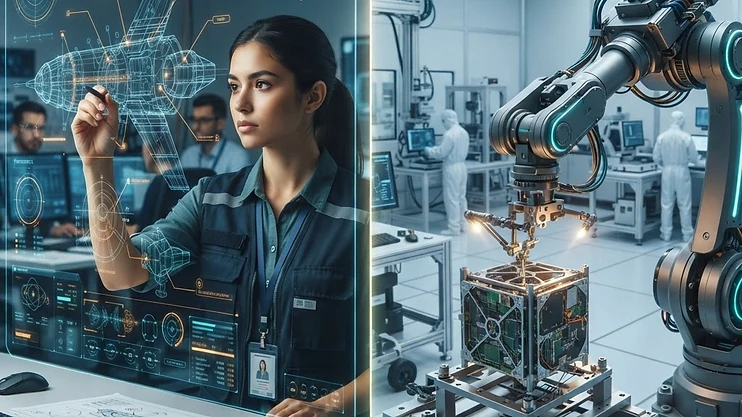
The temptation to use AI to optimize costs is immense. Yet, the long-term health of the Space Coast's aerospace cluster depends on the continuous development of human expertise.
The integration of Artificial Intelligence into the aerospace and defense sectors is no longer a theoretical exercise; it is a daily operational reality in Melbourne and across the Space Coast. From automated satellite processing to predictive maintenance on launch pads, AI is fundamentally altering the nature of work. However, a recent warning from labor researchers suggests that this transition carries a hidden risk: the potential to reduce hiring for entry-level roles, effectively breaking the apprenticeship model that has long sustained the region's technical workforce.
For companies like L3Harris and the growing cohort of startups in the region, the temptation to use AI to optimize costs is immense. Yet, the long-term health of the Space Coast's aerospace cluster depends on the continuous development of human expertise. If AI is used to replace the 'bottom rungs' of the career ladder, the industry risks creating a talent vacuum that will be impossible to fill in five years. The challenge for local business leaders is to design AI adoption strategies that augment human capability rather than replacing the foundational experience that junior engineers need to become experts.
This is not a call to halt innovation, but a call to be intentional about how that innovation is deployed. The Space Coast has a unique opportunity to lead in 'human-centric AI'—a model where technology handles the drudgery, allowing junior staff to focus on higher-level problem solving earlier in their careers. If we get this right, we can accelerate the development of our workforce; if we get it wrong, we risk losing the next generation of aerospace professionals to other industries or regions.
What happened
Recent data from Stanford, highlighted in local discussions, shows that employment among workers aged 22 to 25 in AI-exposed occupations is 19% lower than it would have been without the current wave of automation. This is not necessarily due to mass layoffs, but rather a significant reduction in hiring for entry-level positions. On the Space Coast, where the aerospace industry relies heavily on a pipeline of talent from local universities and technical programs, this trend is particularly concerning.
Simultaneously, Space Florida has launched a $1.5 million NASA-backed workforce hub aimed at building talent in cybersecurity, logistics, and advanced manufacturing. This initiative is a direct response to the need for a more sophisticated workforce, but it must now contend with the reality that AI is changing the very jobs these students are training for. Employers are finding that while they need fewer people for manual data entry or basic monitoring, they need more people who can manage the AI systems themselves. The gap between the skills being taught and the skills being demanded is widening, and the 'AI-exposed' nature of these roles is accelerating that divergence.
Why it matters
If the Space Coast allows the 'bottom rungs' of the career ladder to be automated away, it will fundamentally change the region's economic trajectory. Aerospace is a field that requires deep, tacit knowledge—the kind of 'gut feeling' that only comes from years of hands-on experience. If junior engineers are not given the opportunity to perform the basic tasks that build this knowledge, we will end up with a workforce that is technically proficient in using AI tools but lacks the fundamental understanding of the systems they are managing.
In 2-3 years, this will manifest as a 'seniority crisis.' Companies will have plenty of AI-assisted junior staff but a shortage of the seasoned professionals required to oversee complex, high-stakes aerospace projects. This will drive up wages for the few remaining experts and potentially lead to safety or quality control issues as the 'human-in-the-loop' becomes less experienced. The companies that thrive will be those that treat AI as a tool for mentorship, using it to provide junior staff with better data and faster feedback loops, rather than using it to eliminate their roles.
The breakdown
- The Apprenticeship Gap: AI is automating the entry-level tasks that traditionally served as the training ground for junior engineers. Without these tasks, the path to becoming a senior professional becomes opaque and significantly longer.
- The Hiring Slowdown: The 19% reduction in hiring for young workers in AI-exposed fields is a warning sign that the Space Coast must address. If local firms stop hiring juniors, they are effectively cutting off their own future supply of senior talent.
- Workforce Hubs as a Solution: The $1.5 million NASA-backed hub is a critical intervention, but it must focus on 'AI-augmented' skills rather than just traditional technical training. Students need to learn how to work with AI, not just how to work in a field that uses it.
- The 'Human-in-the-Loop' Risk: As AI takes over more decision-making, the risk of 'automation bias' increases. Junior staff who have never performed the manual tasks may not have the intuition to know when the AI is making a mistake.
- Competitive Advantage of Human Expertise: In the high-stakes world of aerospace, human judgment remains the ultimate safety feature. Companies that prioritize human development will have a significant competitive advantage in reliability and innovation.
- AI as a Mentorship Tool: The most effective use of AI is to provide junior staff with real-time guidance and diagnostic support. This can actually accelerate the learning process, allowing juniors to reach proficiency faster than they would have in a traditional model.
- Regional Economic Stability: The Space Coast's economy is built on the strength of its workforce. If the region becomes a place where only senior experts are hired, the local talent pipeline will dry up, forcing companies to look elsewhere for labor.
Key takeaways
- AI is reducing entry-level hiring, threatening the long-term talent pipeline for the Space Coast's aerospace industry.
- Companies must design AI adoption strategies that augment human learning rather than replacing entry-level roles.
- The $1.5 million workforce hub must pivot to focus on 'AI-augmented' technical skills to remain relevant.
- Human judgment remains the critical safety component in aerospace, and it cannot be fully automated.
Our view
Most coverage of AI in the workplace focuses on the threat of displacement, but the real threat to the Space Coast is the 'hollowing out' of the career ladder. We believe that companies that use AI to eliminate entry-level roles are making a short-sighted mistake that will cost them dearly in the long run. The 'seniority crisis' is coming, and it will be the defining challenge for aerospace HR departments in the next three years.
We think the most successful companies will be those that use AI to create 'super-juniors'—entry-level employees who are empowered by AI to perform at a higher level than their predecessors. This requires a fundamental shift in management philosophy, moving away from 'task-based' hiring to 'capability-based' hiring. The companies that get this right will win the war for talent, while those that rely on AI to cut costs will find themselves unable to innovate when the next generation of complex challenges arises. The Space Coast has the opportunity to set the standard for this new model of work, but it requires a commitment to human development that goes beyond the current focus on efficiency.
What to do about it
- Redesign Entry-Level Roles: Instead of automating tasks, use AI to provide junior staff with better tools for analysis and decision-making, ensuring they still gain the necessary hands-on experience.
- Implement 'AI-Mentorship' Programs: Use AI to provide real-time feedback and diagnostic support to junior engineers, accelerating their learning curve.
- Focus on 'Human-in-the-Loop' Training: Ensure that all training programs emphasize the importance of human judgment and the ability to override or question AI-generated outputs.
- Engage with Workforce Hubs: Local businesses should actively participate in the $1.5 million NASA-backed hub to ensure that the curriculum aligns with the actual needs of the industry, specifically regarding AI-augmented workflows.
The bottom line
The AI revolution in aerospace is inevitable, but its impact on the workforce is a choice. By prioritizing the development of human talent alongside technological advancement, the Space Coast can ensure its long-term competitiveness. The goal should not be to replace the human, but to make the human more capable. If we succeed, we will build a more resilient and innovative industry; if we fail, we risk losing the very talent that makes the Space Coast a global leader.